Kimi K3 on Moonshot as a Coding Agent: Wiring It Into OpenClaw, Benchmarking It Against dsh, and Asking It for a Pixel-Art Logo Widget
- Category
- AI & Local LLM
- Posted
- September 12, 2026
- Updated
- September 12, 2026
- By
- Jacob Lloyd — written with AI assistance, post-project
- Read time
- 23 min read
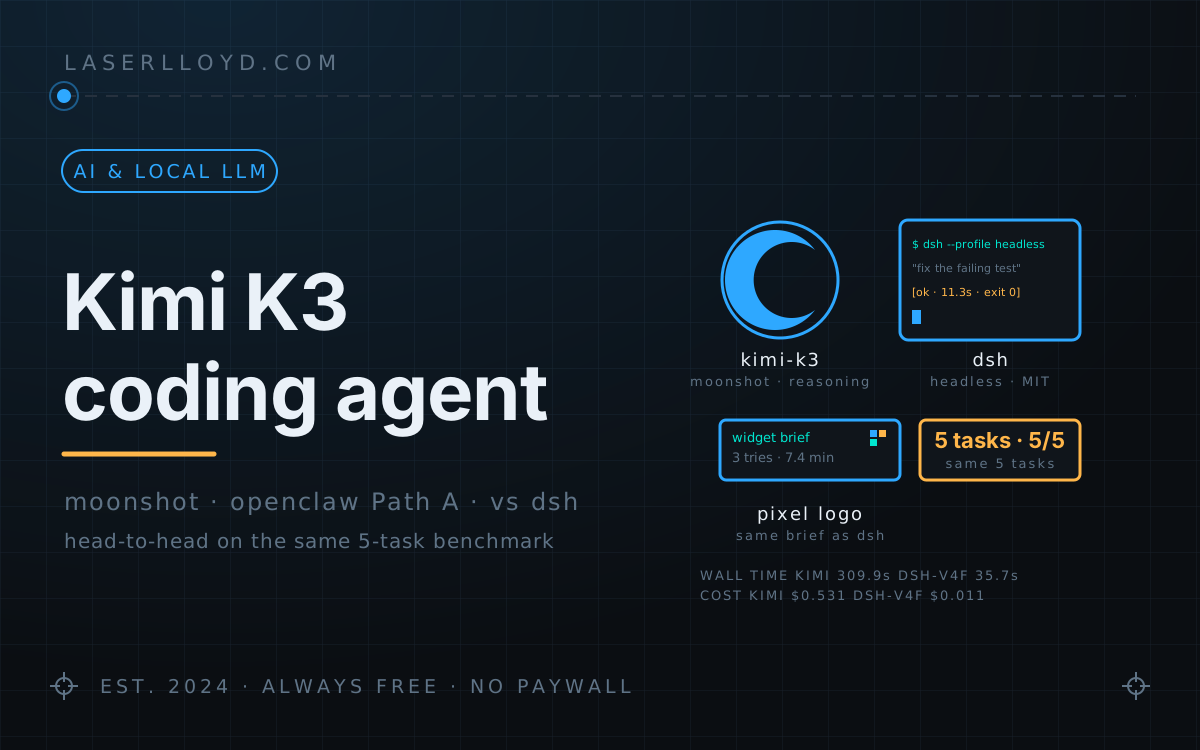
In plain terms: I plugged Moonshot's Kimi K3 reasoning model into the agent software I run at home, gave it the same five small coding jobs I used in August to test DeepSeek's coding assistant (dsh), and asked it to build a pixel-art version of this site's logo from the same written brief. It passed all five jobs, but took about nine times longer and cost about 48 times more than dsh on DeepSeek's fast model. The logo widget took three tries. The first thought for about nine minutes and produced no widget. The second did build a working widget, but put it in the wrong folder and ran out of time before telling me, so I only found it later. The third worked after I shortened the brief and told it to skip planning.
I pointed my OpenClaw worker agent at Kimi K3, Moonshot's flagship reasoning model, and ran it through the same five small coding jobs I used in August to benchmark DeepSeek Harness (dsh). Kimi passed all five. Against dsh on DeepSeek V4-Flash, re-run the same day on the same five tasks, it took about 9 times longer (309.9 s vs 35.7 s) and cost about 48 times more ($0.531 vs $0.011). Then I handed it the pixel-art logo brief dsh built its widget from. Kimi needed three attempts. The first, with the brief unedited, produced no widget. The second, with the same brief, wrote a complete widget into the wrong folder and was cut off by my timeout before it said so, so at first I missed it. The third worked after I shortened the brief and told it to skip planning.
tl;dr
- What it is: Kimi K3 through Moonshot's OpenAI-compatible API, driving OpenClaw's native agent loop (I call this Path A). It is not the Codex app-server: the Codex harness plugin only accepts OpenAI provider routes (checked in OpenClaw 2026.9.2's own code).
- The setup: the Moonshot provider plugin (
@openclaw/moonshot-provider2026.9.2), base URLhttps://api.moonshot.ai/v1,MOONSHOT_API_KEYin the gateway's environment. My model entry allows reasoning effortlow,highandmax, refusestemperature, and caps context at 262,144 tokens of the advertised 1,048,576. - The benchmark: five tasks, fresh folders. Kimi K3: 5/5, 309.9 s, $0.531. dsh on V4-Flash, second (warm) pass on the same five tasks: 5/5, 35.7 s, $0.011.
- The widget: three attempts. Attempt 1 was stopped after 8.8 minutes with no widget code. Attempt 2 wrote a complete 323-line widget and its own tests, but into the worker's workspace instead of the folder I was watching, and hit its 15-minute timeout before replying. Attempt 3, with a shortened brief headed
TARGETED — write the widget file in one tool call, no exploration, no planning, no verification loop., finished in 7.4 minutes for $0.47. The widget on this page is attempt 3's; it passesnode --checkand mounts without errors. - Cost and cache: 80% of Kimi's prompt tokens came from the cache. Without it the same run would have cost about $1.49 instead of $0.53. The rates are $3 input, $15 output and $0.30 cache-read per million tokens.
- Where Kimi sits now: Kimi was my worker's model for this benchmark. As of 2026-09-11 my worker runs MiniMax-M3; Kimi K3 still backs my review agent.
Path A vs Path B, honestly
Everything here is Path A: Kimi K3 driving OpenClaw's own agent loop through the Moonshot provider. On my box the provider was already configured, so switching the worker to Kimi was a single model change.
Path B would put Kimi behind the actual Codex app-server, which OpenClaw's Codex harness plugin runs (the plugin manages @openai/codex 0.153.4). I did not build it, and nothing in this article runs through Codex. The reason is in the plugin's code: its route check, configuredModelRouteNeedsCodex, returns false for any provider whose normalized id is not openai. Moonshot's provider id is moonshot, so a moonshot/kimi-k3 route never reaches the Codex runtime.
The known workaround is codex-router, a local bridge that points Codex at an endpoint on 127.0.0.1:4202 and forwards to Kimi (per its README). For the harness to see that setup, the plugin's appServer.homeScope has to be "user", and that shares your native ~/.codex (or $CODEX_HOME) with the harness instead of isolating Codex state per OpenClaw agent. I haven't decided I'm fine with that, so Path B stays on paper.
Path A has limits you should know about. The turn reports agentHarnessId: "openclaw", the same shape as any other OpenClaw-native model. You don't get Codex thread resume, Codex's own compaction, the dynamic-tool bridge, or the app-server execution model. If you need those, Path B is the only route.
Setup: what I ran it on
These are the commands I ran on my box on 2026-09-11, with their real output:
$ node -v
v24.18.0
$ openclaw --version
OpenClaw 2026.9.2 (3928bad)
$ dsh --version
0.1.1-rc.2
$ openclaw plugins list --json | jq -c '.plugins[] | select(.id=="moonshot") | {id, enabled, version}'
{"id":"moonshot","enabled":true,"version":"2026.9.2"}
$ openclaw config get models.providers.moonshot.models.0.compat
{
  "supportsReasoningEffort": true,
  "supportsTemperature": false,
  "supportedReasoningEfforts": [
    "low",
    "high",
    "max"
  ]
}
$ openclaw config get models.providers.moonshot.models.0.contextTokens
262144
Three things worth knowing before you run anything:
- K3 always reasons. The plugin sends
reasoning_effort: "max"by default and acceptslow,highandmax; I ran the benchmark with--thinking max. It also strips sampling overrides (temperature,top_pand friends) because K3 fixes them, and my model entry says the same thing withsupportsTemperature: false. Even "Reply with exactly: PONG." spent 53 reasoning tokens. - The 1M context is advertised; I cap it. OpenClaw's Moonshot catalog lists K3 at 1,048,576 tokens of context. I set
contextTokens: 262144on the model entry so sessions compact at the same point as my other models. Expect 256k in practice with that cap, not 1M. - The cache does the heavy lifting on price. Every task starts with about 15k tokens of system prompt and tool definitions. After the first step most of that is read from the cache at $0.30 per million instead of $3. On the rename task, cache reads alone came to 157,952 tokens.
The route, basic to advanced
Steps 1 to 3 get you a working model. Steps 4 and 5 are what I did next.
Step 1: install the plugin and give it the key
These are the steps from OpenClaw's own Moonshot docs. On my box the plugin and key were already in place, so I only ran the check on the last line (its output is in the setup block above):
openclaw plugins install @openclaw/moonshot-provider
openclaw gateway restart
openclaw plugins list --json | jq -c '.plugins[] | select(.id=="moonshot") | {id, enabled, version}'
The plugin reads the key from MOONSHOT_API_KEY. I keep it in the environment file my gateway service loads, and my openclaw.json has no key in it. The docs also offer openclaw onboard --auth-choice moonshot-api-key if you'd rather be walked through it. The default endpoint is https://api.moonshot.ai/v1, and the China region uses https://api.moonshot.cn/v1 (auth choice moonshot-api-key-cn).
The plugin's catalog includes K3, K2.7 Code and K2.7 Code HighSpeed. It handles the Kimi quirks for you: K2.7 needs both thinking and reasoning_effort left out of the request, which the plugin does. Watch the env var name. MOONSHOT_API_KEY is the Moonshot Open Platform. KIMI_API_KEY belongs to the separate Kimi Code subscription route (kimi/kimi-for-coding).
Step 2: point your worker agent at K3
The relevant parts of my openclaw.json during the benchmark, with my worker agent renamed to worker:
{
  agents: {
    entries: {
      worker: {
        model: {
          primary: "moonshot/kimi-k3",
          fallbacks: ["deepseek/deepseek-v4-flash", "deepseek/deepseek-v4-pro"],
        },
      },
    },
  },
  models: {
    providers: {
      moonshot: {
        baseUrl: "https://api.moonshot.ai/v1",
        api: "openai-completions",
        timeoutSeconds: 1200,
        models: [
          {
            id: "kimi-k3",
            name: "Kimi K3",
            reasoning: true,
            input: ["text", "image"],
            cost: { input: 3, output: 15, cacheRead: 0.3, cacheWrite: 0 },
            contextWindow: 1048576,
            maxTokens: 131072,
            contextTokens: 262144,
            compat: {
              supportsTemperature: false,
              supportsReasoningEffort: true,
              supportedReasoningEfforts: ["low", "high", "max"],
            },
          },
        ],
      },
    },
  },
}
One trap cost me a quiet regression: on OpenClaw 2026.9.2 a compat block in your model entry replaces the plugin's own compat object. It does not merge. An earlier version of my entry named only supportsTemperature: false, and that silently dropped the plugin's reasoning-effort support. If you write compat at all, write the whole object, as above.
The contextTokens: 262144 line is the cap from the setup notes. If you raise it, expect cache-read spend and per-turn latency to grow with the session.
Step 3: the smoke test, and the JSON it gives you
Each benchmark task was one call like this, with a fresh session key every time:
openclaw agent --agent <your-agent-id> --model moonshot/kimi-k3 --thinking max \
  --session-key "<fresh-key>" --message-file prompt.txt --json > out.json
Here are the fields that matter, pulled from the saved envelope of the PONG task:
$ jq '.result | {harness: .meta.agentMeta.agentHarnessId, model: .meta.executionTrace.winnerModel, usage: .meta.agentMeta.usage}' out.json
{
  "harness": "openclaw",
  "model": "kimi-k3",
  "usage": {
    "input": 15068,
    "output": 70,
    "reasoningTokens": 53,
    "total": 15138,
    "cost": {
      "total": 0.046254
    }
  }
}
harness: "openclaw" is Path A's signature. A turn running through the Codex app-server would say "codex". winnerModel: "kimi-k3" tells you the turn really ran on K3 and didn't fall back to something cheaper. reasoningTokens is counted inside output (the total is input plus output), so the 53 reasoning tokens are part of the 70.
Side by side: Kimi K3 in OpenClaw vs dsh
Both are agent loops that read files, run shell commands and bill per token. They differ in who makes what and in how you drive them.
| Kimi K3 in OpenClaw (Path A) | dsh | |
|---|---|---|
| Who makes it | Model: Moonshot AI. Agent loop: OpenClaw | DeepSeek (model and harness), MIT |
| Call it from a script | openclaw agent --agent <id> --model moonshot/kimi-k3 -m "…" --json | dsh --profile headless "…" |
| Switch models | The agent's model.primary in openclaw.json | ~/.dsh/settings.yaml |
| Headless benchmark, 5 small tasks | 309.9 s, ≈ $0.531, 5/5 | 35.7 s, ≈ $0.011, 5/5 (V4-Flash, warm second pass) |
| Pixel-art widget, same brief | 3 attempts, two of which produced a widget; the one shown here took 7.4 min and ≈ $0.47 | 2 attempts; the one that worked took 25 min and ≈ 49¢ |
| Version tested | OpenClaw 2026.9.2, Moonshot plugin 2026.9.2 | 0.1.1-rc.2 (developer preview) |
Earlier comparisons on this site had a Reasonix column. I retired Reasonix from my machine on 2026-09-09, so it isn't here; its July article stays up as a historical record. I also ran MiniMax M3 through the same suite; MiniMax is a separate company from Moonshot, and that run gets its own write-up.
The benchmark: the same 5 tasks
These are the same five tasks the dsh article ran, each in a fresh scratch folder, with a fresh session per Kimi task. I re-ran dsh on V4-Flash the same day on the same five tasks, pinned to deepseek-v4-flash in a scratch settings file. The prompt wording wasn't identical. dsh runs in the folder you launch it from, so its prompts said "the current directory". Kimi's prompts gave the absolute path of each task folder, and Kimi's bug-fix prompt added "if pytest is not available, install it with 'pip install --user pytest' first" (pytest was already installed, and Kimi never ran the install). That column is the second pass: the first pass took 44.8 s and $0.024 with a cold cache, and the second is the one I compare against everywhere in this article. The V4-Pro and Gemma-4-26B columns are from the dsh article in August and were not re-run. Wall time covers the whole process. Kimi's tokens and cost come from OpenClaw's JSON envelope, and dsh's from its own session log.
| Task | Kimi K3 (Path A) | dsh V4-Flash (same day) | dsh V4-Pro (Aug, historical) | Gemma-4-26B (Aug, historical) |
|---|---|---|---|---|
| Reply "PONG" (boot + one call) | ✅ 6.1 s · 0 tools | ✅ 1.7 s · 0 tools | ✅ 2.8 s | ✅ 13.2 s* |
| Write + run FizzBuzz | ✅ 22.8 s · 2 tools (write, exec) | ✅ 5.3 s · 3 tools | ✅ 8.4 s · 2 tools | ✅ 4.9 s · 2 tools |
| Fix 2 bugs so unit tests pass (tests untouched) | ✅ 86.6 s · 6 tools (exec, write, edit) | ✅ 11.3 s · 7 tools | ✅ 15.8 s · 7 tools | ✅ 10.4 s · 8 tools |
| Summarize a 6-module codebase (<150 words) | ✅ 65.5 s · 10 tools (read, exec, write) | ✅ 5.1 s · 7 tools | ✅ 10.9 s · 7 tools | ✅ 12.1 s · 7 tools |
| Rename a function across 3 files + tests, prove green | ✅ 128.9 s · 9 tools (exec, write; one sed across files) | ✅ 12.3 s · 11 tools | ✅ 18.2 s · 12 tools | ✅ 12.2 s · 11 tools |
| Total wall time | 309.9 s | 35.7 s | 56.1 s | 52.8 s |
| Tokens: input miss / cache-read / output (reasoning) | 91,470 / 355,328 / 9,990 (4,053) | 6,141 / 147,328 / 4,697 (1,984) | 41.4k / 107k / 3.2k | 40.5k / 237k / 5.6k |
| Cost | ≈ $0.531 ($3 / $15 / $0.30 per M) | ≈ $0.011 ($0.44 / $1.32 / $0.014 per M) | ≈ $0.072 | $0 (electricity only) |
Tool counts are tool calls. Kimi's come from toolSummary.calls in OpenClaw's JSON envelope, with the tool types in brackets; dsh's come from its session log. *First call after the model was cold-loaded on the rig. Kimi rates are the ones in my OpenClaw catalog entry, which OpenClaw uses to compute each task's cost; check Moonshot's pricing page for current numbers. dsh V4-Flash cost uses the same peak rates as the dsh article (DeepSeek pricing); the V4-Pro and Gemma rows are that article's figures.
What the table says:
- 5/5 in every column. None of these tasks tripped Kimi up. The bug fix left the tests untouched, and the rename was one
sedacross four files followed by a clean test run and an emptygrepfor the old name. - Kimi spends more on thinking. K3 used 53, 241, 315, 1,586 and 1,858 reasoning tokens across the five tasks (4,053 total). dsh on V4-Flash also reasons, just less: 0, 52, 834, 5 and 1,093 (1,984 total). Most of Kimi's extra time is thinking and extra steps.
- The cache carries the bill. Across the five tasks Kimi sent 91,470 uncached input tokens and read 355,328 from the cache, so 80% of its prompt tokens came from the cache. Billed as uncached input, those same tokens would have made the run about $1.49 instead of $0.53.
- For small chores, V4-Flash wins. 35.7 s for the suite at about $0.011 is about 9× faster and 48× cheaper than Kimi on the same tasks, with the same result. The rename alone took Kimi 128.9 s and $0.180, and dsh 12.3 s and $0.0043.
The fun test: the same widget brief, Kimi vs dsh
The dsh article's "fun test" was a pixel-art widget of this site's logo, built by dsh on V4-Flash from a written brief. I handed Kimi the same brief, unedited, and timed it. The brief:
Brief: interactive pixel-art LaserLloyd logo widget
Build a self-contained, embeddable pixel-art version of the LaserLloyd logo (see
reference-logo.png: a thick blue ring, colour #1f3f8f on white, containing two interlocking italic/slanted capital "L"s — the upper-left L's foot runs under the lower-right L's stem, like the letters are stacked diagonally).Deliverables (all in this folder)
ll-pixel-logo.js— ONE vanilla-JS file, no dependencies, no build step, no network requests. Any page can embed it with:<div class="ll-pixel-logo" data-size="320"></div>+<script src="ll-pixel-logo.js"></script>. It finds every.ll-pixel-logoelement and mounts a<canvas>inside it. Responsive: canvas fills the container width (square), crisp on HiDPI (devicePixelRatio). Exposewindow.LLPixelLogo.mount(el).index.html— a demo page showing the widget at 3 sizes with a short caption of the interactions.README.md— how to embed, the interactions, and any knobs (data- attributes).The art
- A pixel grid of 40×40 cells. DO NOT hand-draw a bitmap (no rows of '#'/'.' strings — that is slow and error-prone). Instead RASTERISE it procedurally from geometry: a function
isLit(col,row)that returns true for (a) the ring: distance from centre between 0.82R and R, and (b) two slanted Ls, each built from two parallelograms (a stem sheared ~20° and a foot), the upper-left L's foot sitting just under the lower-right L's stem, like the reference. Tune the few constants so it reads as the reference logo at 200px. Precompute the lit cells once at mount.- Palette: logo blue #1f3f8f; highlight blue #2ea8ff; amber #ffb64a; cyan #00e6cf; background transparent.
Interactions (the point of the exercise — make them delightful)
- Mouse over / touch move: pixels near the pointer react physically — e.g. they're pushed away from the cursor like a fluid/ magnetic repulsion, then spring back with damping; while displaced they glow toward #2ea8ff/#00e6cf. Smooth 60fps via requestAnimationFrame; no jank.
- Click / tap: something cool and satisfying. Pick ONE strong effect and do it well, e.g. the whole logo shatters into pixels that fly outward with gravity/bounce, then reassembles itself into the logo again (about 1.5–2 s); or a "laser" sweeps across and re-engraves the logo pixel by pixel with glowing sparks. Repeat clicks should feel good (don't break mid-animation).
- Idle: a subtle ambient life (a slow shimmer or an occasional pixel twinkle) so it never looks dead, but nothing distracting.
- Respect
prefers-reduced-motion: reduce(render the static logo, keep hover glow only).- Works with mouse AND touch. No scroll hijacking.
Quality bar
- Clean, commented code; no globals except
LLPixelLogo. Tab-size 2. Under ~400 lines.- Runs from
file://with zero console errors. Test it yourself: write a tiny node script or open it with whatever you have to at least syntax-check and exercise the module (e.g. jsdom is NOT available — do anode --checkand a DOM-free unit check of the bitmap, e.g. count lit cells and assert the ring + two Ls are present in the right quadrants).- Finish by printing a short report: what you built, how to embed, and what you verified.
How Kimi handled it:
- Attempt 1 (the brief, unedited): stopped after 8.8 minutes, no widget code, ≈ $0.31. K3 looked at the reference logo, reasoned about geometry and tool plans, and never wrote any of the deliverables. dsh's first attempt failed in a similar way (a 10-minute loop drawing a bitmap in its head), though the brief then still allowed hand-drawn bitmaps.
- Attempt 2 (the brief again, fresh session): a complete widget, in the wrong place, ≈ $0.72. About eight minutes in it wrote a 323-line
ll-pixel-logo.js, then a demo page, a README and two test files, ran its tests and adjusted them until they passed, and wrote a short report. All of it went into the worker agent's own workspace rather than the folder my script was watching, and the session hit its 15-minute timeout before it replied. From where I was watching, attempt 2 had produced nothing, and I didn't wait for it: I started attempt 3 about seven minutes in. - Attempt 3 (a shortened brief plus a directive): 7.4 minutes, all three files written, ≈ $0.47. I kept the deliverables, art and interactions, put
TARGETED — write the widget file in one tool call, no exploration, no planning, no verification loop.at the top, and replaced the testing section with a line endingDo NOT do a "node --check" or playwright test — just write the files and print a short report listing what you wrote.The widget has pointer repulsion with spring-back, shatter-and-reassemble on click, an idle shimmer and twinkle, and a reduced-motion mode. My checks are in the next section.
So the three attempts took 8.8, 15 and 7.4 minutes and cost about $0.31, $0.72 and $0.47: about $1.50 for two widgets. Attempt 3's cost comes from its own JSON receipt. Attempts 1 and 2 ended without one, so their figures are OpenClaw's per-message costs for each session, added up; the same sum for attempt 3 matches its receipt.
Attempt 2's widget turned up again about an hour later, when a MiniMax M3 run on the same worker found the files, ran their tests and reported them as its own work. That story is in the MiniMax M3 write-up, and both of Kimi's widgets sit next to dsh's in the pixel-art widget showdown.
What Kimi produced, first ~30 lines of ll-pixel-logo.js:
/*!
 * ll-pixel-logo.js — interactive pixel-art LaserLloyd logo widget.
 *
 * Self-contained vanilla JS: no dependencies, no build step, no network.
 * Embed on any page with:
 *
 *   <div class="ll-pixel-logo" data-size="320"></div>
 *   <script src="ll-pixel-logo.js"></script>
 *
 * Every .ll-pixel-logo element gets a <canvas> mounted inside it at load.
 * Programmatic API: window.LLPixelLogo.mount(el) -> instance.
 *
 * Art: 40x40 pixel grid, rasterised procedurally from geometry (ring + two
 * interlocking italic Ls). Interactions: pointer repulsion with spring-back,
 * click/tap shatter-and-reassemble, idle shimmer/twinkle, reduced-motion
 * support. Mouse and touch. No scroll hijacking (all listeners passive).
 */
(function () {
  'use strict';

  // -- constants ------------------------------------------------------------
  var VERSION = '1.0.0';
  var GRID = 40;                                // logical grid: GRID x GRID cells
  var BLUE   = [31, 63, 143];                   // #1f3f8f logo blue
  var HILITE = [46, 168, 255];                  // #2ea8ff highlight blue
  var AMBER  = [255, 182, 74];                  // #ffb64a twinkle amber
  var CYAN   = [0, 230, 207];                   // #00e6cf max-displacement glow

  var CENTER = GRID / 2;                        // grid centre coordinate (20)
  var R_OUT = 19;                               // ring outer radius (cells)
  var R_IN = 0.82 * R_OUT;                      // ring inner radius
  var SLANT = Math.tan(20 * Math.PI / 180);     // ~20 deg italic shear
And here it is running, Kimi K3's build, untouched:
prefers-reduced-motion.Kimi builds each L from two parallelograms (a sheared stem and a foot) with a small makeL helper, tests points with an inPara helper inside isLit, and keeps every tuning constant (ring radii 0.82R to R, a 20° slant from Math.tan, spring and damping) in one block at the top of the file.
The files Kimi wrote (the 397-line ll-pixel-logo.js, a 40-line index.html and a 79-line README.md) are served from /assets/uploads/2026/09/kimi-codex/, next to the brief as BRIEF.md.
For comparison, the first ~30 lines of dsh's widget, as served from /assets/uploads/2026/08/deepseek-harness/ll-pixel-logo.js:
/*!
 * ll-pixel-logo.js — interactive pixel-art LaserLloyd logo widget.
 * Vanilla JS, zero dependencies, no network requests, works from file://.
 *   <div class="ll-pixel-logo" data-size="320"></div>
 *   <script src="ll-pixel-logo.js"></script>
 * Auto-mounts on .ll-pixel-logo elements; window.LLPixelLogo.mount(el) too.
 * Knobs: data-size, data-speed, data-static.
 */
(function (global) {
  'use strict';
  // ---- 0. palette -----------------------------------------------------
  var BLUE = [31, 63, 143];      // #1f3f8f — logo blue
  var HI = [46, 168, 255];       // #2ea8ff — hover / repulsion glow
  var AMBER = [255, 182, 74];    // #ffb64a — twinkle spark
  var CYAN = [0, 230, 207];      // #00e6cf — deep glow
  // ---- 1. art: procedural 40x40 raster (no hand-drawn bitmap) ----------
  // A cell is lit when it belongs to the ring or to one of the two slanted
  // interlocking Ls. Each L is two parallelograms (stem + foot), described by
  // top-left (ax,ay), width w, height h, sheared by SLANT (bottom edge shifts
  // left): TL=(ax,ay) TR=(ax+w,ay) BL=(ax-SLANT*h,ay+h). The upper-left L's
  // foot runs right and tucks under the lower-right L's stem, like the ref.
  var GRID = 40;                 // cells per side
  var RING_R = 19.7;             // outer ring radius (cells)
  var RING_IN = 0.80 * RING_R;   // inner ring radius (reference ~0.808R)
  var SLANT = 0.453;             // shear of stems/feet (~24deg)
  var LETTERS = [
    { ax: 15.0, ay: 5.2, w: 4.2, h: 10.6 },   // upper-left L: stem
    { ax: 10.2, ay: 15.8, w: 15.0, h: 3.8 },  // upper-left L: foot
    { ax: 24.7, ay: 13.8, w: 4.2, h: 14.7 },  // lower-right L: stem
    { ax: 18.0, ay: 28.5, w: 15.0, h: 3.8 }   // lower-right L: foot
  ];
The two widgets are built the same way: both rasterise a ring and two interlocking italic Ls from geometry, both expose window.LLPixelLogo.mount, and both honour prefers-reduced-motion. The constants differ. dsh uses an outer ring radius of 19.7, an inner ring at 0.80R and a slant of 0.453 (about 24°); Kimi uses 19, 0.82R and 20°. Kimi's strokes are also thinner: its stems and feet are 3 cells thick, where dsh's stems are 4.2 cells wide and its feet 3.8 tall. That's why Kimi's logo lights 510 cells and dsh's 656. Neither matches the reference logo exactly, and both read as the mark at a glance. dsh's second attempt also wrote a Node unit test and, unprompted, a Playwright script. Kimi's third attempt was told to skip testing, and it did.
Verification commands I ran on Kimi's widget
I re-ran these on 2026-09-11 against the copy this page serves, from inside /assets/uploads/2026/09/kimi-codex/:
$ wc -l ll-pixel-logo.js
397 ll-pixel-logo.js
$ node --check ll-pixel-logo.js && echo "node --check passed"
node --check passed
Two more checks were my own private ones, run with two small helper scripts (under 20 lines each) that I haven't published, so here is the method rather than commands you can paste:
- Lit-cell count. I loaded the widget file in Node with a stubbed-out DOM (no-op canvas, window and document objects), captured the file's own
isLit(col, row)function, and called it on every cell of the 40×40 grid, tallying the lit cells by quadrant. It lit 510 cells: 124 upper-left, 103 upper-right, 160 lower-left and 123 lower-right. - Mount check. With the same stubbed DOM, I confirmed that the file defines
window.LLPixelLogoas an object and that callingmount()on a stub element returns an object instead of throwing.
The ring alone (cells whose centres sit between 0.82R and R, with R = 19) accounts for 352 of the 510 cells, which leaves 158 for the two Ls. The helper scripts are mine, not Kimi's, and they're only a smoke test, not a browser run: the page you're reading is the browser run.
Gotchas (the ones I actually hit)
- "OpenAI-compatible" does not mean "Codex-harness-compatible". Moonshot's
/v1/chat/completionsworks fine as an OpenClaw provider, but the Codex harness plugin only accepts routes whose provider id isopenai. If you specifically need Codex thread resume and the dynamic-tool bridge, Path B (the codex-router bridge) is the only option. See Path A vs Path B above. - K3 always reasons, even on trivial replies. "Reply with exactly: PONG." spent 53 reasoning tokens. That's by design and it's predictable; budget for it.
- A
compatblock replaces, it doesn't merge. If you addcompatto the model entry to refusetemperature, copy the plugin's reasoning-effort fields in too, or you silently lose them. - The 1M context is advertised, not what you get with my cap. The catalog says 1,048,576 tokens; my
contextTokens: 262144means sessions compact at 256k. Raise it on purpose, not by accident. - The cache discount is real, but the rates are flagship rates. $0.30 per million cache-read tokens is about 21× dsh V4-Flash's $0.014. The cache still cut this run to about a third of the no-cache price.
- Open-ended creative briefs can stall a reasoning model, and a timeout can hide a success. Attempt 1 thought for 8.8 minutes and wrote no widget code. Attempt 2 wrote a working widget, then ran out the clock with its files in the wrong folder, so it looked like a second failure. What got me a widget where I expected it was a shorter brief headed
TARGETED — write the widget file in one tool call, no exploration, no planning, no verification loop., with the target folder spelled out. K3 still reasons with that wording; it just doesn't plan forever. Whatever the exit status says, look at what the session wrote. - An error exit doesn't mean the task failed. Check the files. The first FizzBuzz call exited with code 1, named no winning model, and ended with "⚠️ API rate limit reached. Please try again later." as its final text. It had already written
fizz.py, and the file ran correctly. A retry replied "Already created and ran." and only that envelope said completed. My script wrote every run's JSON to the same file, so the failed run's envelope was overwritten; its exit code and final text survive in the log of the session that drove the benchmark. The table uses a later, clean run in a fresh session. - Don't copy a scratch folder from another harness's finished run. I set up Kimi's bug-fix folder by copying the files from dsh's finished folder, after dsh had already fixed them, so Kimi's first bug-fix run found the file already fixed and just verified it. I reset the folder and re-ran in a fresh session; the table has the second run. Separately, dsh works in the directory you launch it from: my first dsh script didn't
cdinto the task folder, wrote files in the wrong place, and I had to re-run all five tasks. - Neither widget matches the reference logo exactly. The brief says to tune the constants so it reads as the logo at 200px. I'd spend ten minutes on the stroke widths and slant before shipping either one.
Where this leaves me
On these five tasks Kimi K3 was correct, slow and expensive. For small chores, dsh on V4-Flash did the same work in about a ninth of the time for about a 48th of the price. After this benchmark I moved my worker agent off Kimi to MiniMax-M3, and Kimi K3 stayed where it already was: behind my review agent, where a slower, more careful answer is worth paying for.
Path B, the codex-router bridge into the actual Codex app-server, stays on paper until I'm comfortable with what homeScope: "user" shares. Until then, "Kimi as a coding agent" on my box means Kimi driving OpenClaw's native loop, the same shape as any other OpenClaw-native model.
Related: DeepSeek Harness (dsh) (the harness I compared against, where the benchmark and the brief come from), MiniMax M3 (the same suite on the model my worker runs as of 2026-09-11), Reasonix (historical; retired from my box on 2026-09-09), and What my AI agents actually cost (the wider pricing comparison).