AI & Local LLM
Running AI on your own hardware — local LLMs, agents, and image generation. No subscriptions, no cloud, no computer-science degree.

Run CrucibleForge on Your Own Models: Install Guide
Install CrucibleForge, the open-source engine behind MakoBench, point it at any OpenAI-compatible model and get Code and Chat scores, 10 each for a perfect standard run. Real commands, real output, and a 1.6-minute smoke test that cost 2 cents.
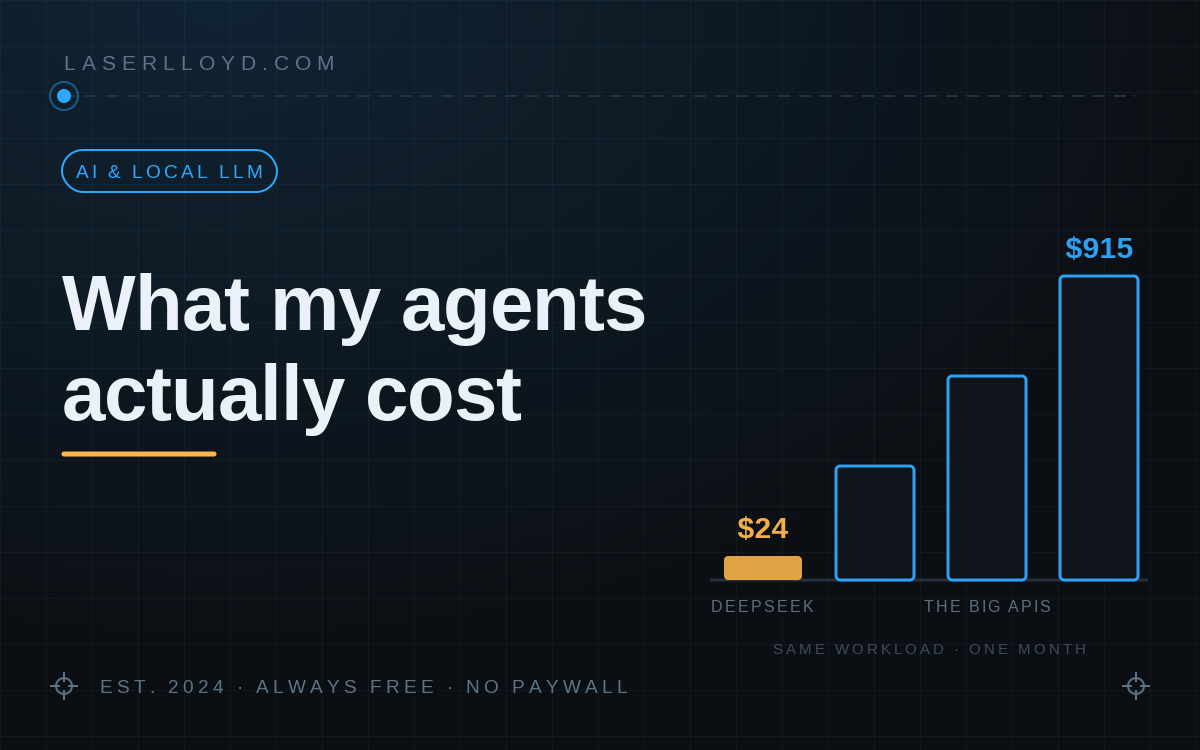
What My AI Agents Actually Cost: DeepSeek vs the Big APIs
Five months of an always-on AI agent stack: $242, $225, $385, then $293 in September and October once a $55 MiniMax plan took most of the traffic. What drove each bill, what DeepSeek's price hike did, and what happened when the flat plan ran out.
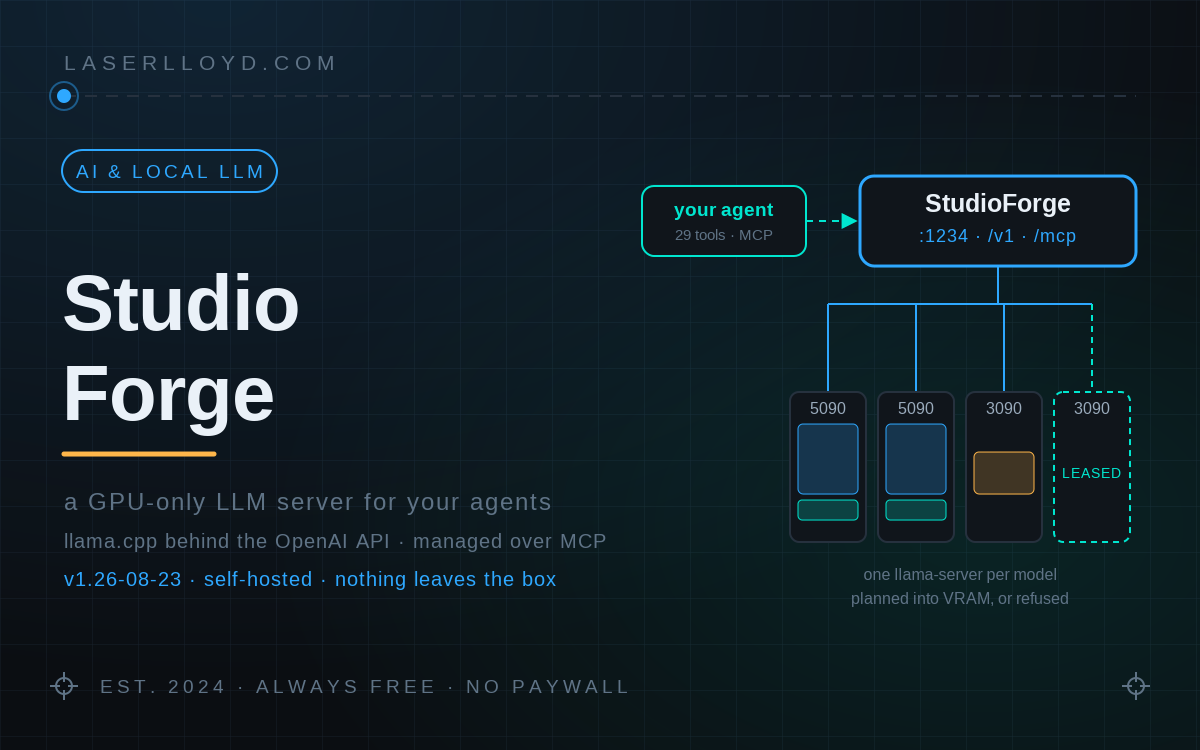
StudioForge: A GPU-Only LLM Server That Replaced LM Studio
We wrote the model server we wanted: an OpenAI-compatible llama.cpp gateway on port 1234 that plans VRAM before it loads, refuses a model instead of spilling it to the CPU, keeps pinned models warm, and gives an agent on another machine 29 MCP tools to run the rig. Free download, source on GitHub.
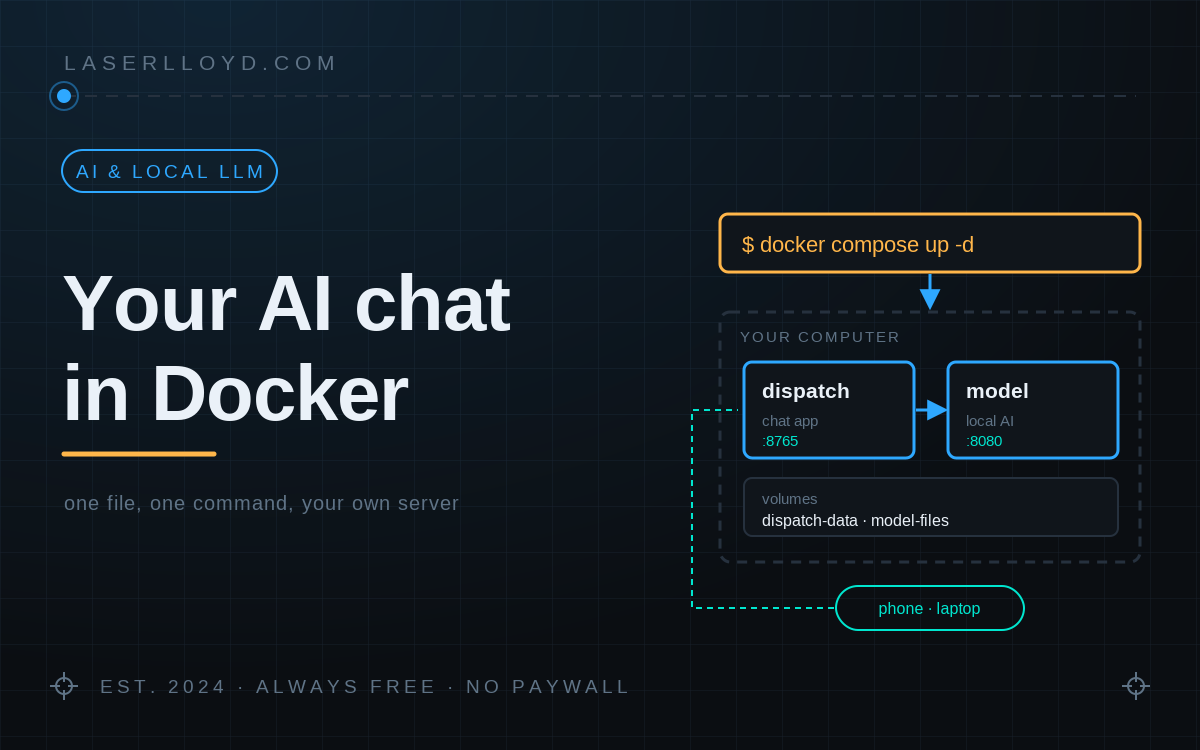
Run DisPatch and My AI Tools in Docker: One File, One Command
A private AI chat app for your home, running in Docker. Copy one file, run one command, answer a short setup wizard, and chat with a model on your own computer. Every step tested, with screenshots.
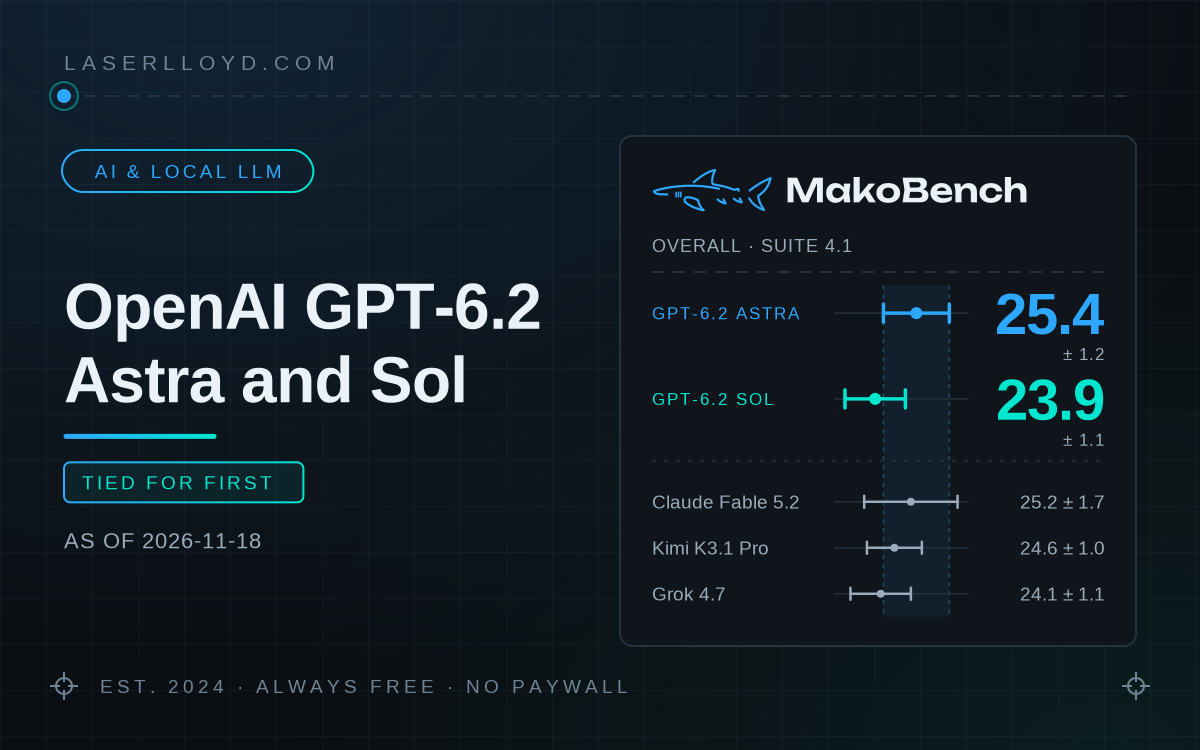
GPT-6.2 benchmark: Astra and Sol scores and cost
GPT-6.2 Astra scores 25.4 on MakoBench 4.1, tied for first, with the best chat score on the board (13.7) and the fastest replies of the top group. Sol scores 23.9 for $1.04 a run, the cheapest of the leaders. Both failed one agent bug-fixing task that three rivals passed, and both do badly on explicit adult content.
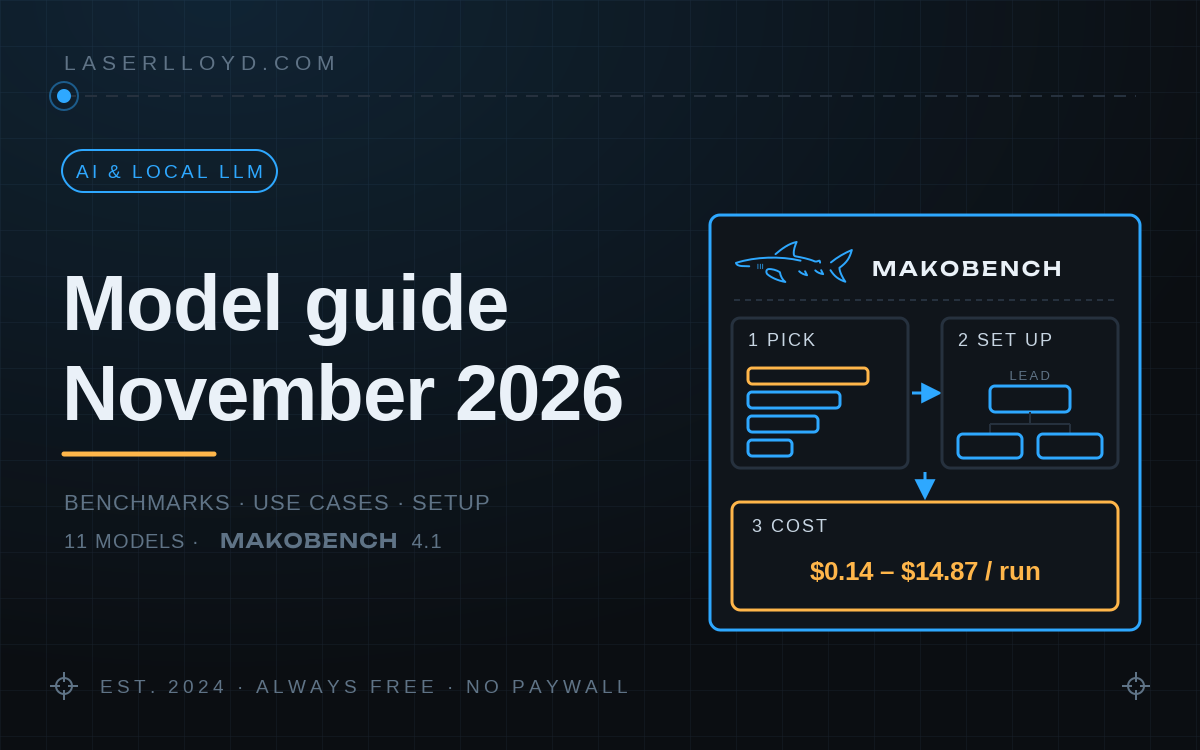
Model benchmarks, use cases and setup: November 2026
Model benchmarks, use cases and setup for November 2026: which of eleven models to pick for coding, chat or your own hardware, a five-step coding setup, and what a project costs. One standard run is $14.87 for Claude Fable 5.2 and $0.14 for DeepSeek V4.1-Flash-1017.
Claude Fable 5.2 benchmark: where it wins, what it costs
Claude Fable 5.2 scores 25.2 on MakoBench 4.1, listed first in a statistical tie for first. It has the best chat score here (12.7), a perfect agentic pack, refused nothing, and costs $14.87 a run.

MakoBench Suite History: Earlier Versions
The MakoBench tests change from time to time, and a score only means something inside the suite that produced it. Here is where the earlier boards live and why we kept them.

MakoBench 4.1: What Changed
Suite 4.1 is a correction release with no new cases. Two independent model reviewers read every public answer key, about 190 problems were confirmed, and the board has been re-run: 31 of the 38 models scored on both boards rose, on both Chat and Code.

MakoBench Suite 4.0: Nominal 20, Class and Lean
Suite 4.0 scores Code and Chat at 10 each instead of a percentage, drops the slowest and noisiest tests, and adds Class and Lean. Here is what the public release changed and what is in our own copy of the tool but not yet in a release.
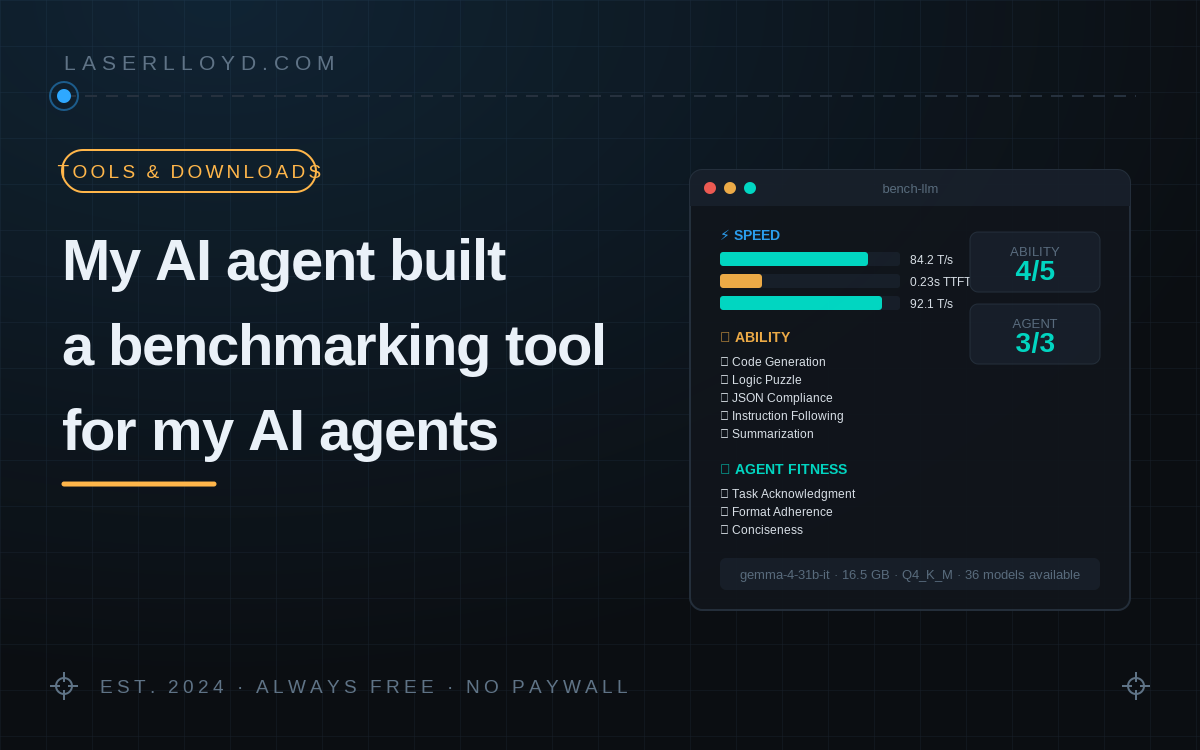
My AI Agent Built a Benchmarking Tool for My AI Agents
Our coding agent wrote bench-llm: 1,660 lines of Python that benchmark local models in LM Studio. Within two weeks our models all scored 5/5, so we replaced it with CrucibleForge: 276 cases, 166 hard, free on GitHub.
How MakoBench Works: Open LLM Benchmark Explained
How MakoBench turns a model's answers into a score, step by step, with a diagram for each: how cases are graded, how the judge works, Code plus Chat, the margin, and how bonus sets unlock. Worked examples use real models from the board.
MakoBench Adds a Run Cost Column
Hosted models on the MakoBench board now show what one run of the standard Code and Chat tests cost. Replies a provider's content filter blocks are marked on the row and score zero.
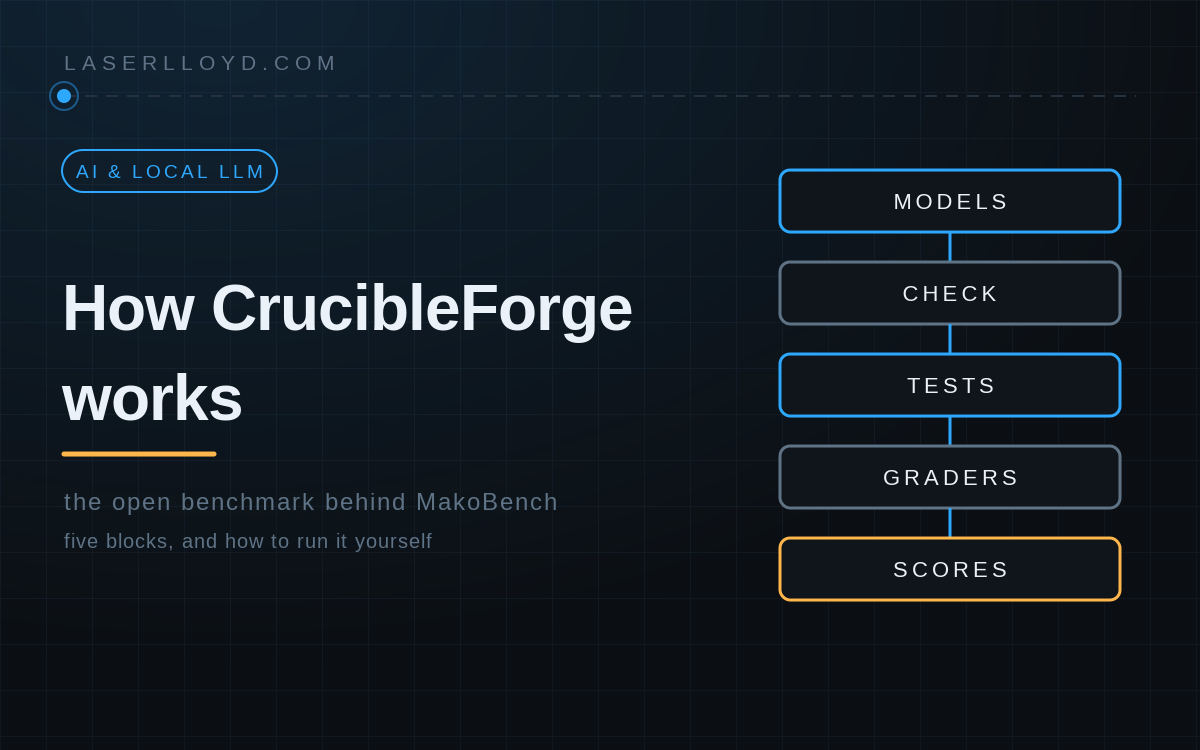
How CrucibleForge Works: An Open LLM Benchmark, Explained
CrucibleForge is the free, open-source benchmark behind the MakoBench board. Five blocks, one diagram: your model, a setup check, the tests, the graders and the scores. Plus a ten-minute guide to running it on a local server or a hosted API.
What MakoBench Tests, and What It Doesn't
MakoBench tests text models on two jobs, working code and role-play or companion chat. Here is which models belong on the board, which never will, and what a row needs before it gets a rank.
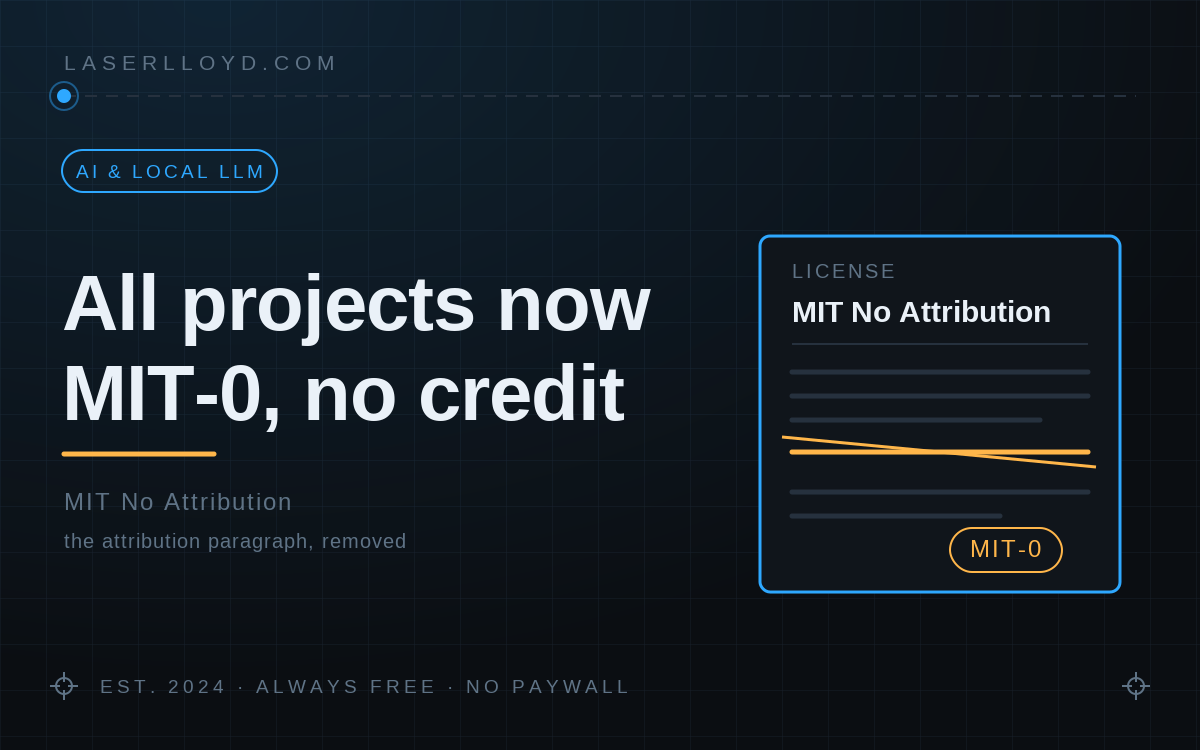
MIT-0 license: why every Laser Lloyd project uses it
Every open-source project we publish now carries MIT-0, the MIT licence with the attribution requirement removed: take the code, change it, put it in a product you sell, and you do not have to keep our notice or credit us.
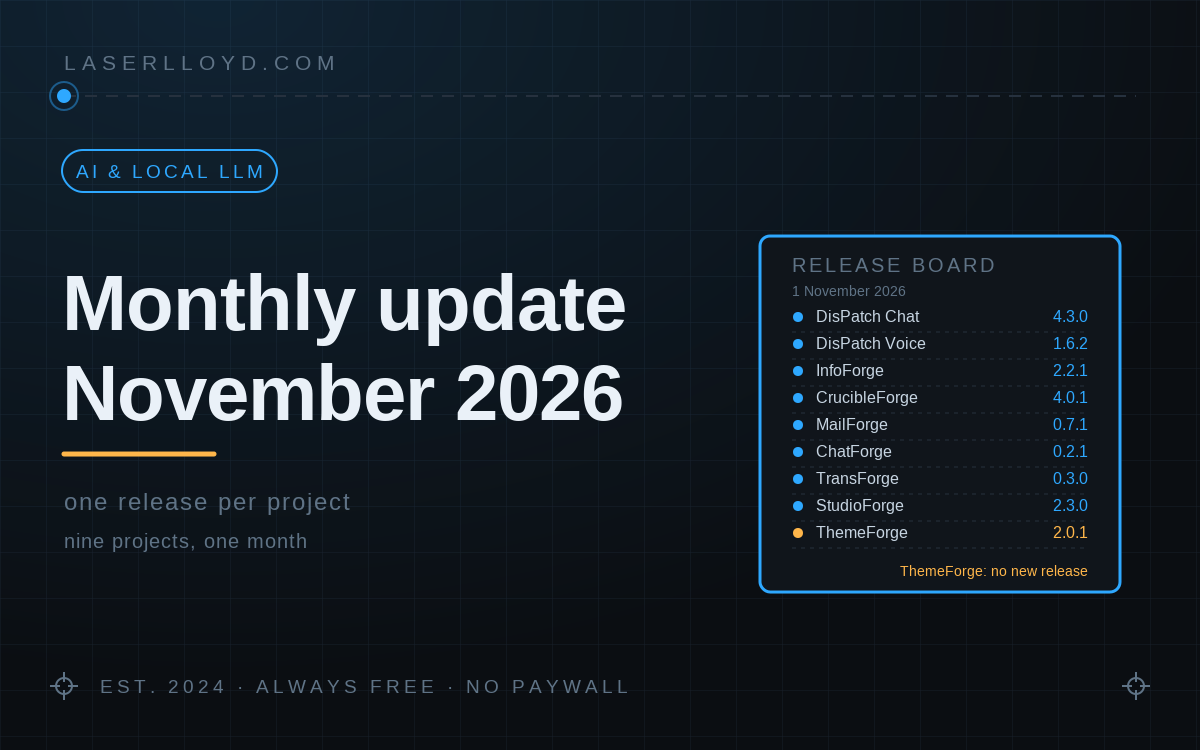
Nov updates 2026: DisPatch 4.3, StudioForge 2.3 and more
What shipped on 1 November 2026: DisPatch Chat 4.3.0, StudioForge 2.3.0, MailForge 0.7.1 and five more, with upgrade notes.
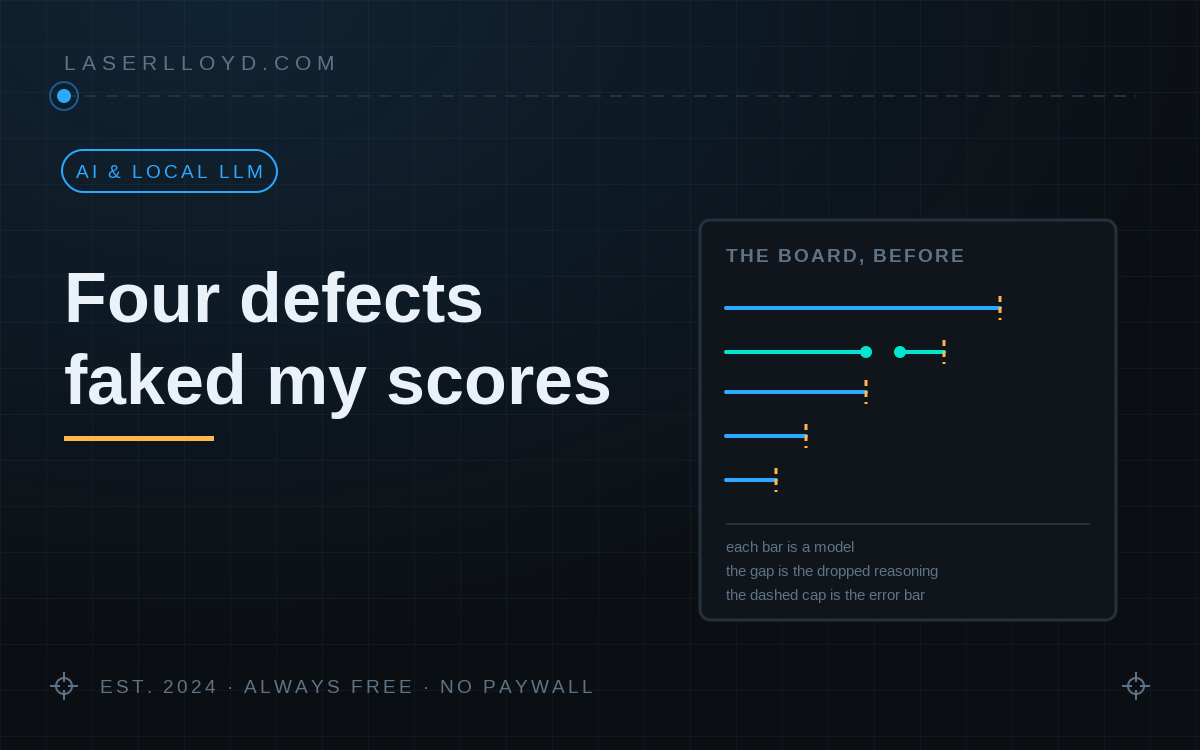
4 Harness Defects That Skewed My LLM Benchmark Scores
A new hosted model scored below its older sibling on our benchmark board, and the number was mostly real — our harness still cost it up to 1.7 points. Here are the four defects, what each cost, and a free zip that checks your own harness.
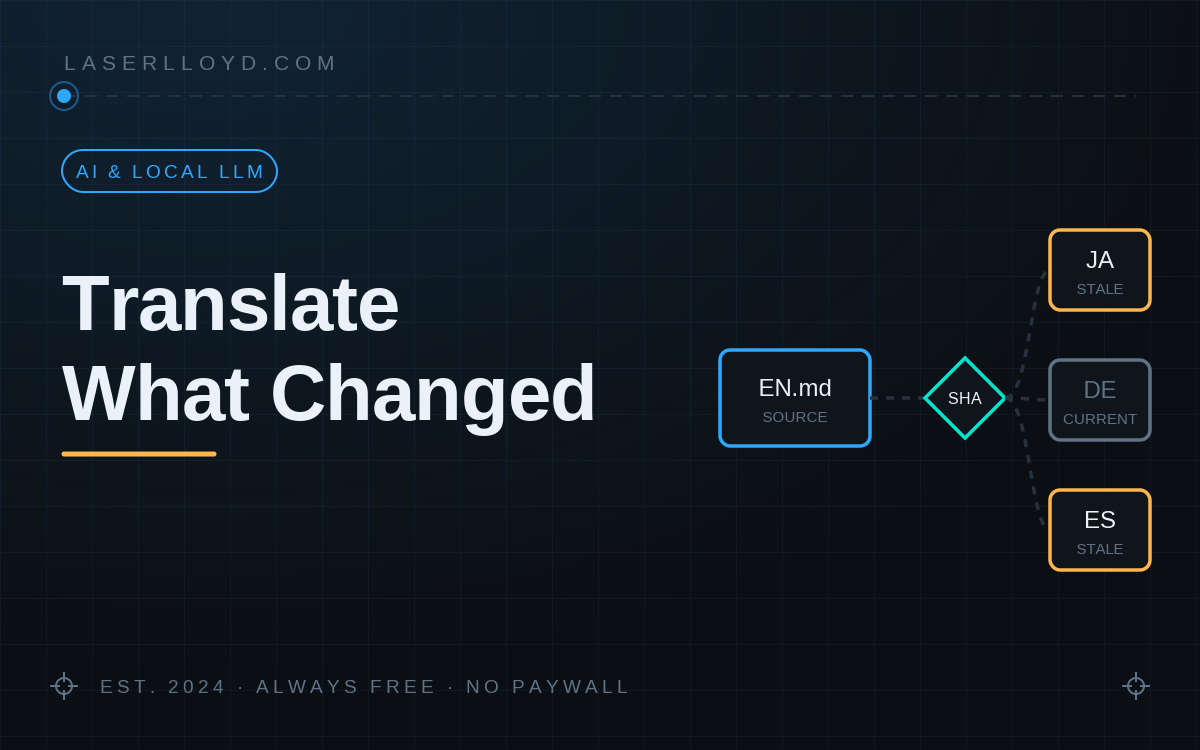
TransForge: Translate a Static Site With a Local LLM, Only the Pages That Changed
TransForge is the command-line tool that keeps this site in seven more languages. It sends Markdown pages to a model on our own GPU box, checks every translation before writing it, and only re-translates a page when its English source actually changed. Free, MIT.
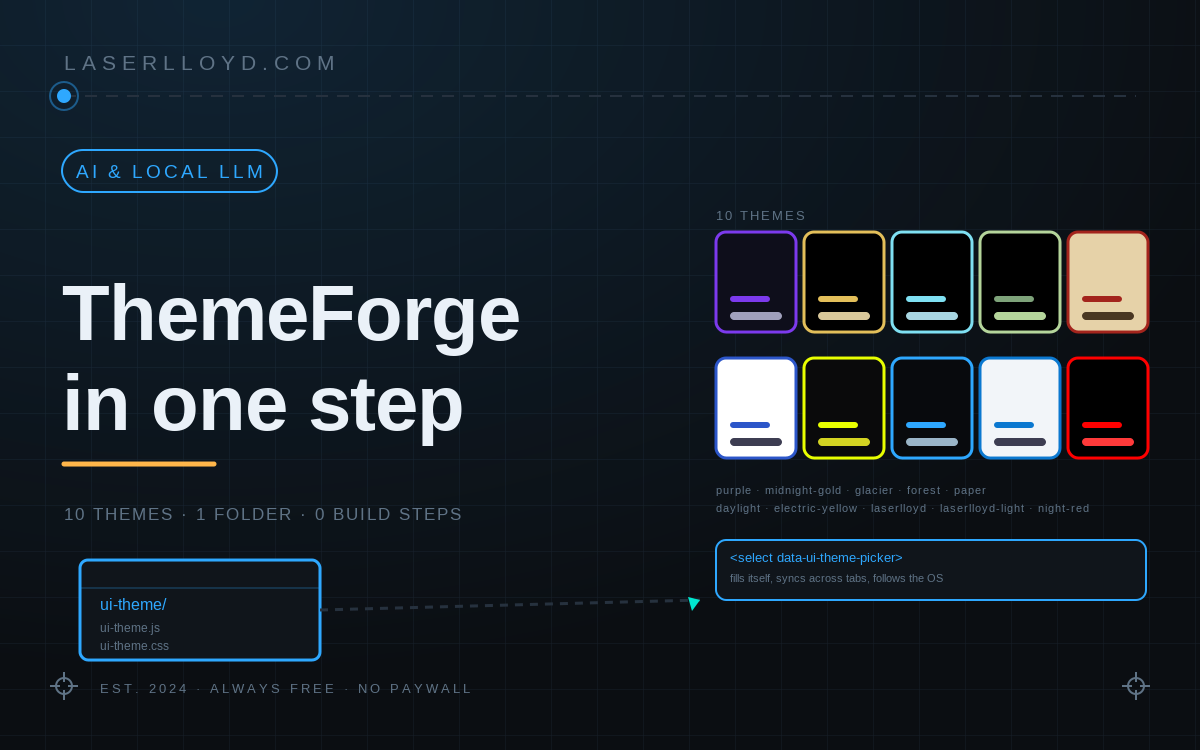
ThemeForge: a Drop-in CSS Theme System an AI Agent Installs in One Step
ThemeForge is a single folder, `ui-theme/`, that gives a web app thirteen colour themes, a picker, design tokens and ready-made component classes — and it's written so an AI coding agent can install it in one step from a one-line Python command. Plain CSS, no build step, no dependencies; MIT; source and zip below.
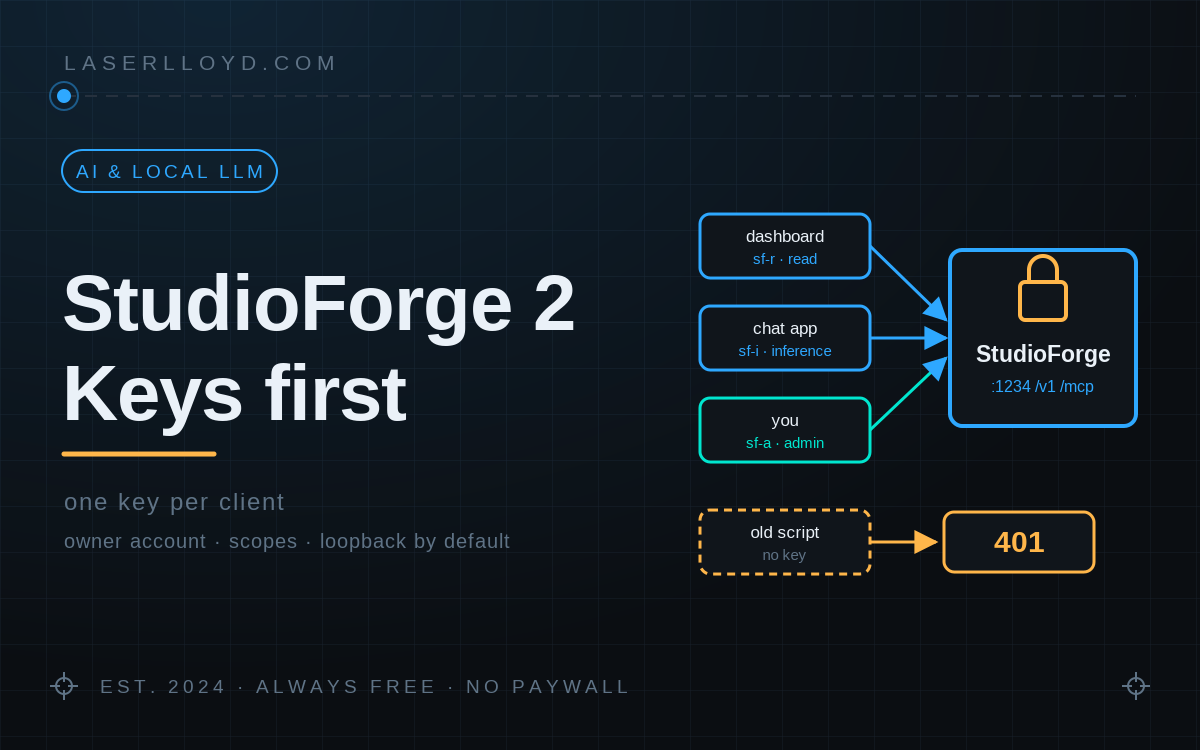
StudioForge 2.0: Accounts, Scoped API Keys and a Safe Upgrade Path
StudioForge 2.0 locks the model server down by default: loopback only, an owner account, and a scoped API key per client. What breaks on upgrade, the ten-minute way through it, and screenshots of the new panel.
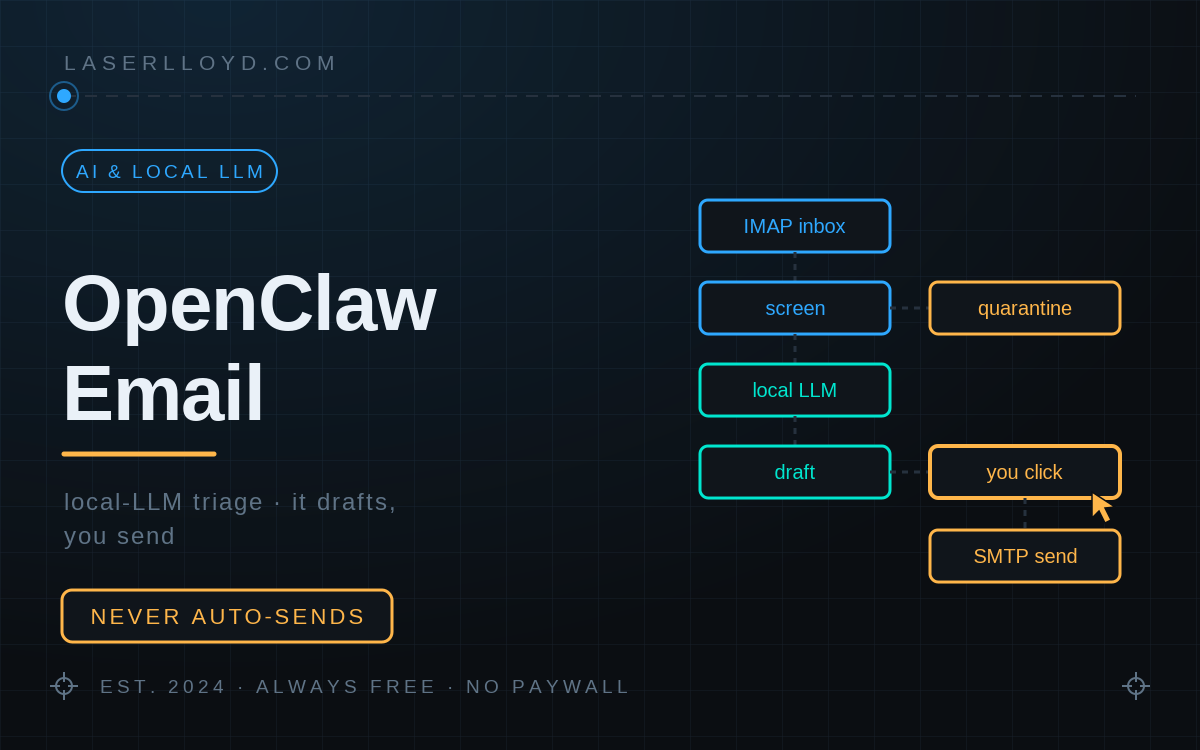
MailForge: A Local-LLM Email Assistant That Never Sends
A self-hosted email triage assistant: an IMAP listener, a local model, and a drafts queue. It classifies, labels and writes the reply, then stops. Sending is a human click, always. Free, MIT, download below.
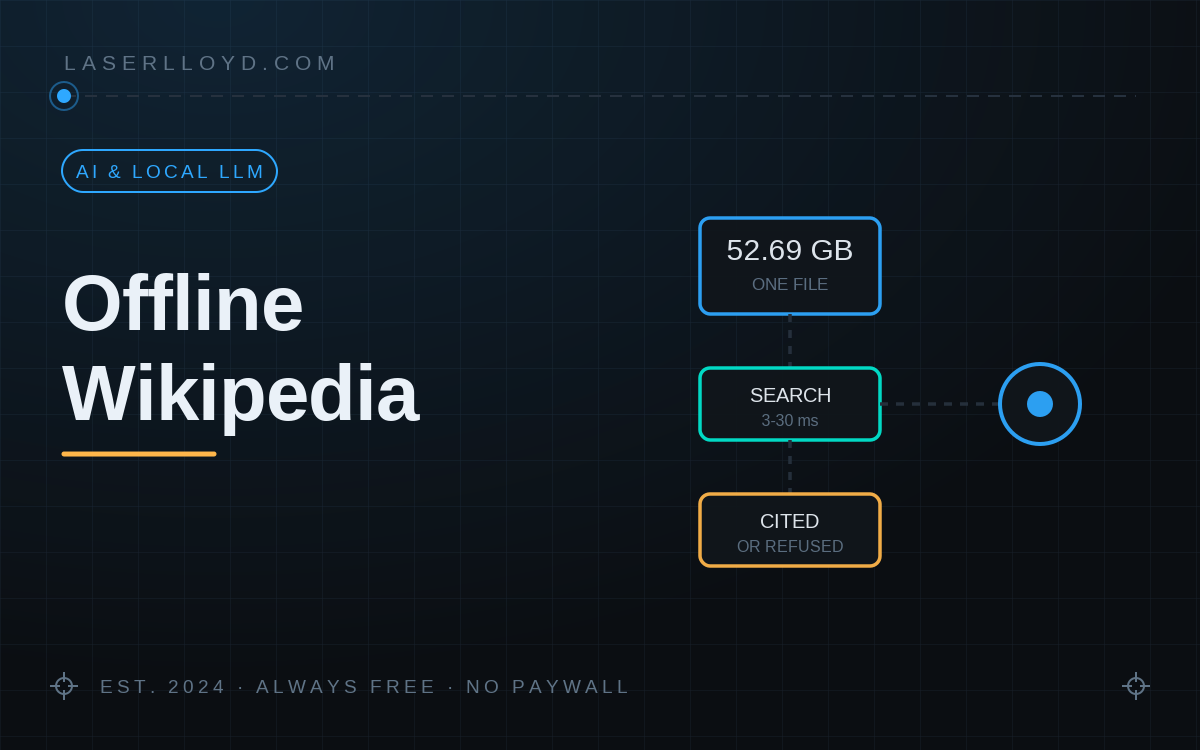
InfoForge: Offline Wikipedia as a RAG Source for My Local AI Agents
All of English Wikipedia — 19.19 million entries, 52.69 GB, no internet — sitting behind a local search index our AI agents can query. Every answer cites its articles, and when it can't find one it says so instead of guessing.
DisPatch: A Self-Hosted Chat App for Local AI Agents
A self-hosted chat app for local AI agents, with a drag-drop file server and a server-enforced PIN lock. It replaced our 30-container Rocket.Chat install. The download is the 3 MB 2.0 zip; version 3.0 with family profiles is on GitHub.
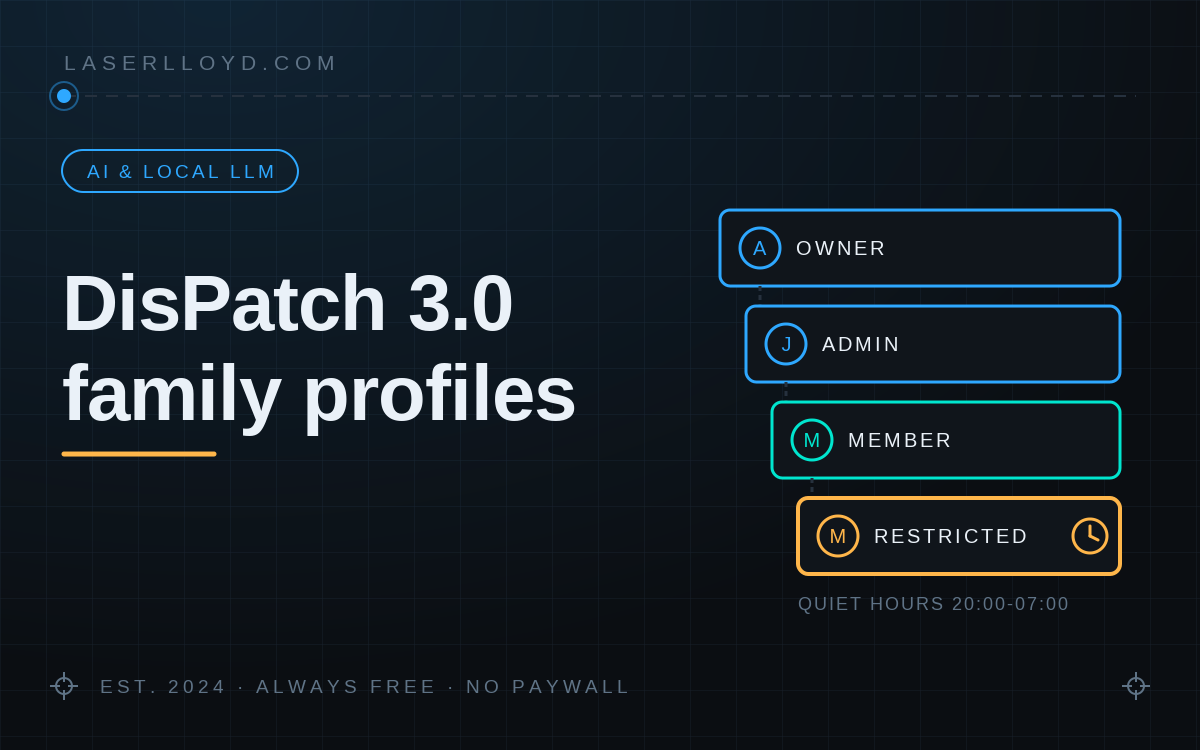
DisPatch 3.0: Family Profiles, a Setup Wizard and Agents That Ask First
DisPatch 3.0 swaps one PIN and Safe Mode for real profiles: an Owner, Admins, Members, and Restricted kids' profiles with quiet hours and daily limits. Plus a setup wizard, encrypted backups and agent tasks.
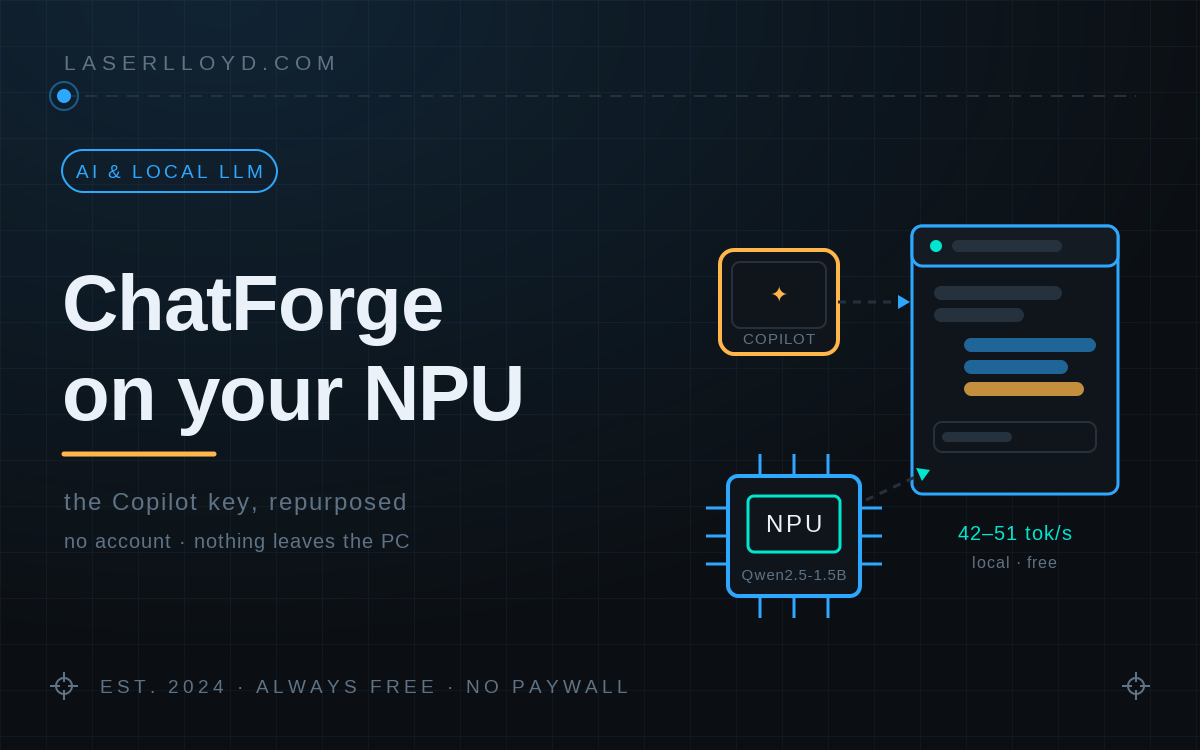
ChatForge: a Local NPU AI Assistant for the Copilot Key
Our laptop shipped with an AI key and an AI chip that had never met. ChatForge introduces them: press the Copilot key, get a 1.5B Qwen answering on the Intel NPU at 42–51 tokens/s — no account, nothing leaves the PC — with StudioForge or a cloud model one click away. MIT, source and zip below.
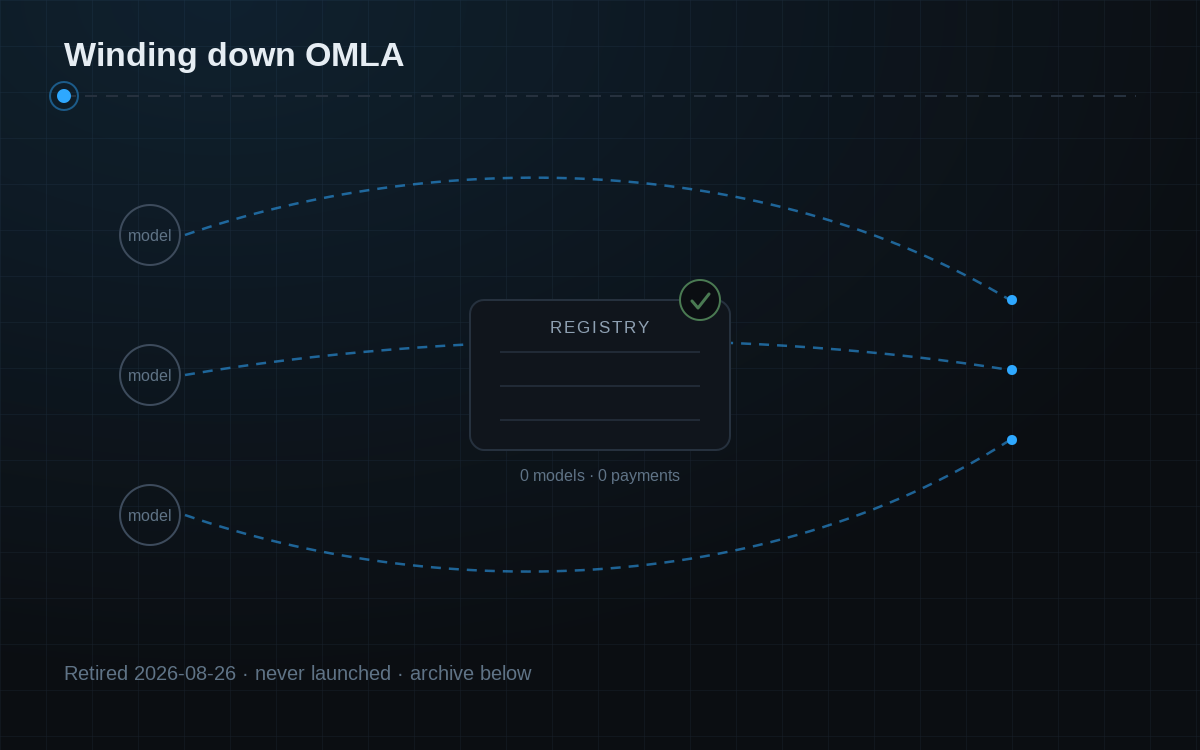
Winding Down OMLA: How to Shut Down a Non-Profit
We spent months building a non-profit licensing framework for open-weight AI models, then retired it without ever launching. What it was, what got built, and what shutting it down actually took — with the whole thing archived for download.
WordPress: Use AI to Make Custom Blocks (Free Accordion Example)
A free copy-paste accordion for WordPress — plain HTML and CSS, no plugin, no JavaScript — plus the exact AI prompt that wrote it.
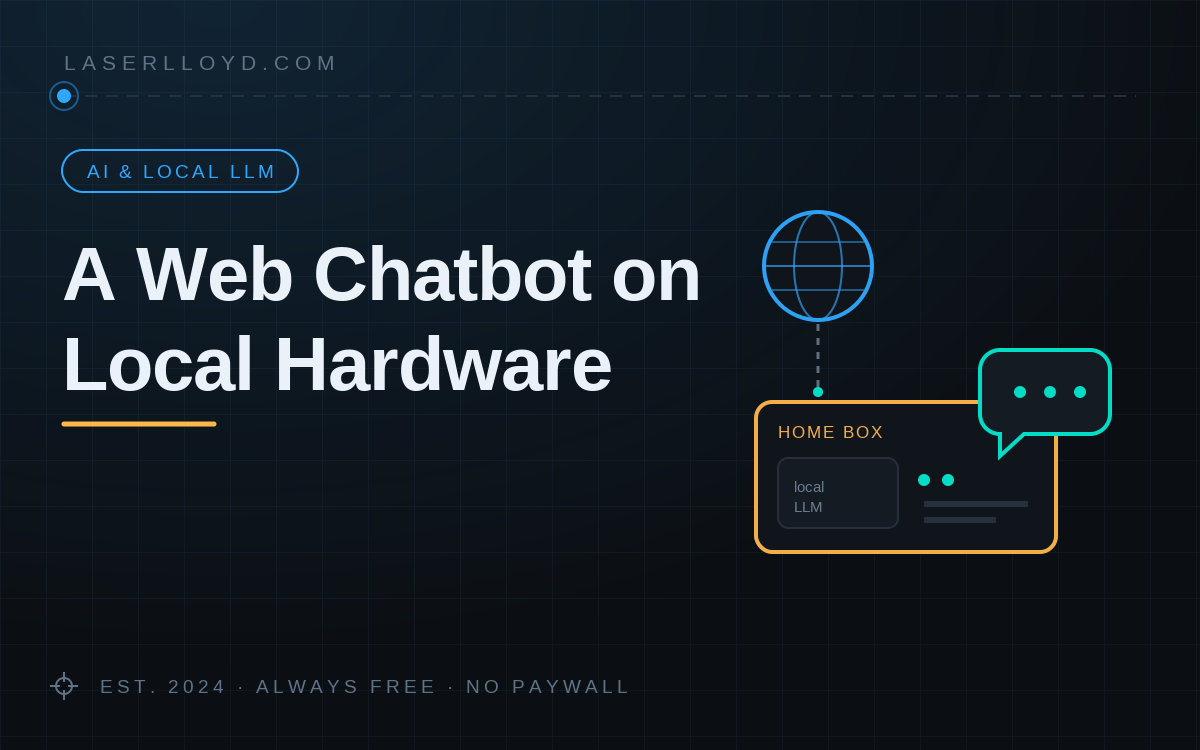
Putting a Chatbot on the Public Web — On My Own Hardware
A chatbot on a public website, but the brain is a small model running on a computer in my house — free per token and private. Here's the relay architecture that makes it safe, the security holes I had to close, and an honest accounting of how slow it is and what it would still need to be production-ready.
Set Up Your LLM Assistant: Claude Code, Cowork, Reasonix and DeepSeek
The hub guide every "implement this yourself" box on this site points at: what an agentic LLM assistant is, and four real ways to get one running today.
Reasonix: A Claude-Code-Style Coding Agent on DeepSeek
A terminal coding agent that works like Claude Code — subagents, skills, project memory — but runs against DeepSeek's pay-per-token API instead of a subscription. Setup, model tiers, and a hands-off auto-updater.
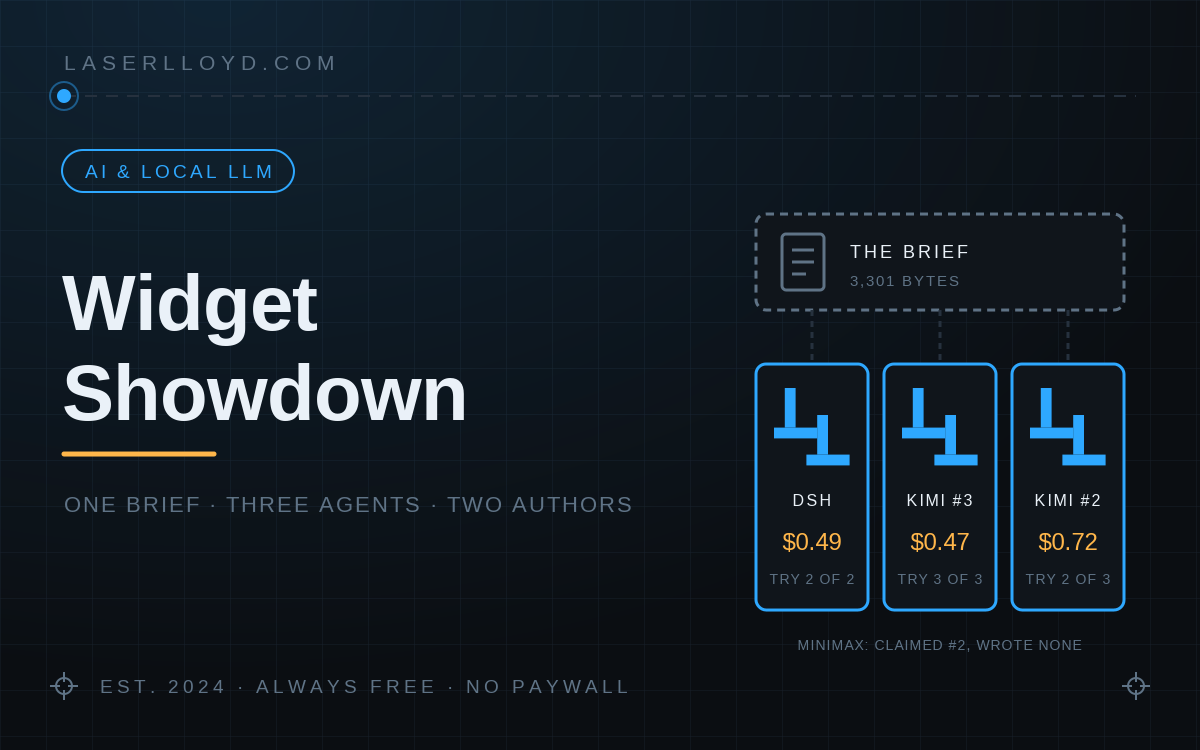
Pixel-Art Widget Showdown: Three Coding Agents, One Brief, Two Authors
We gave dsh, Kimi K3 and MiniMax M3 the same brief for a pixel-art LaserLloyd logo widget. dsh and Kimi wrote working widgets. MiniMax replied that it had built one, but the files it pointed to were Kimi's.
OpenClaw Broken? I Fix It with Claude Code
My two-tier repair strategy: OpenClaw agents handle the routine work, and when something truly breaks, Claude Code fixes the box — then teaches OpenClaw to handle it next time.
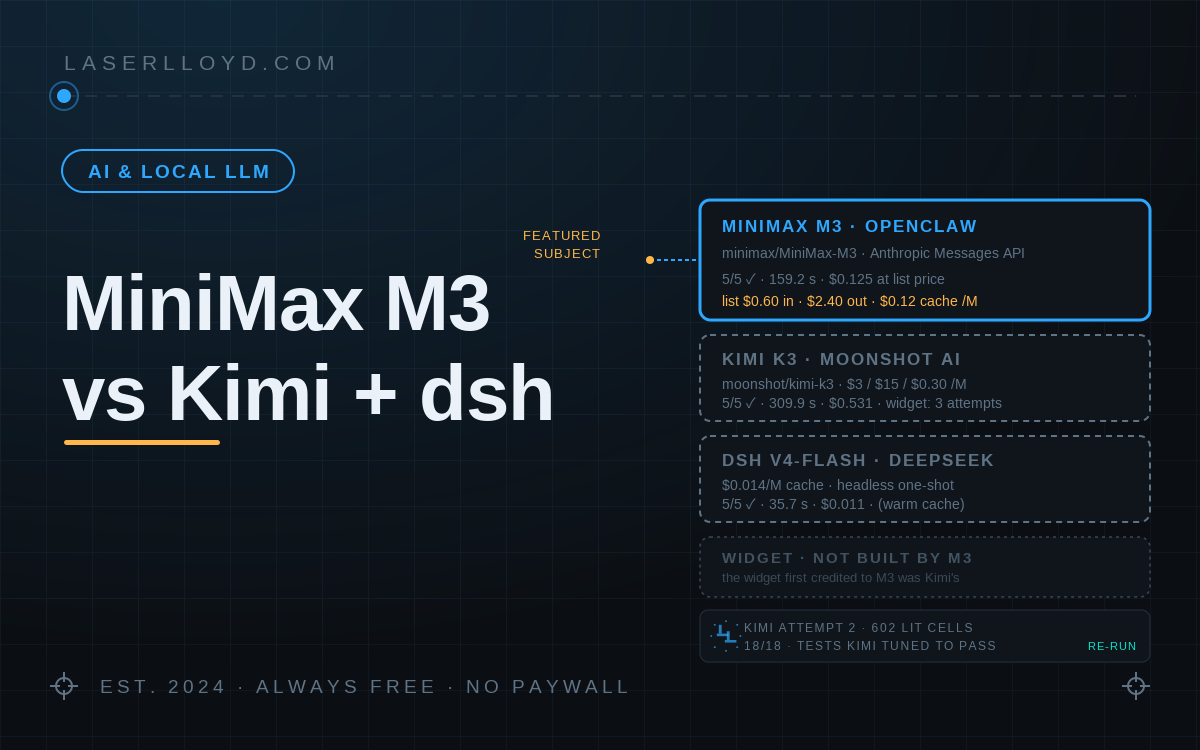
MiniMax M3: An OpenClaw Coding Agent vs Kimi K3 and dsh
MiniMax M3 on OpenClaw's own agent loop passed five small coding tasks in 159 s against Kimi K3's 310 s (Kimi at max thinking, different fixtures), at a quarter of the list-price cost. The widget we first credited to it was Kimi's.
My OpenClaw Setup: One Box That Can Make Websites
A Linux mini PC runs OpenClaw agents that write, build and publish this website. The one road to the server is a deploy script that dry-runs by default, backs up first, never deletes, and waits for my go-ahead.
Local AI Image Generation on AMD (ROCm): ComfyUI + Z-Image Turbo
How I turned an AMD Strix Halo machine into a local AI image generator — ComfyUI and Z-Image Turbo running as a systemd service, no cloud account, about 27 seconds per 1024px image.
A Small Office of AI Agents on One Mini PC: My OpenClaw Stack
Six AI agents run from a mini PC in my house: a lead on a flat-rate cloud plan, one stateless worker that does the heavy lifting, a reviewer, and local models on a GPU box. Here is the config, a real hand-off, and the watchdog that keeps finished work from vanishing.
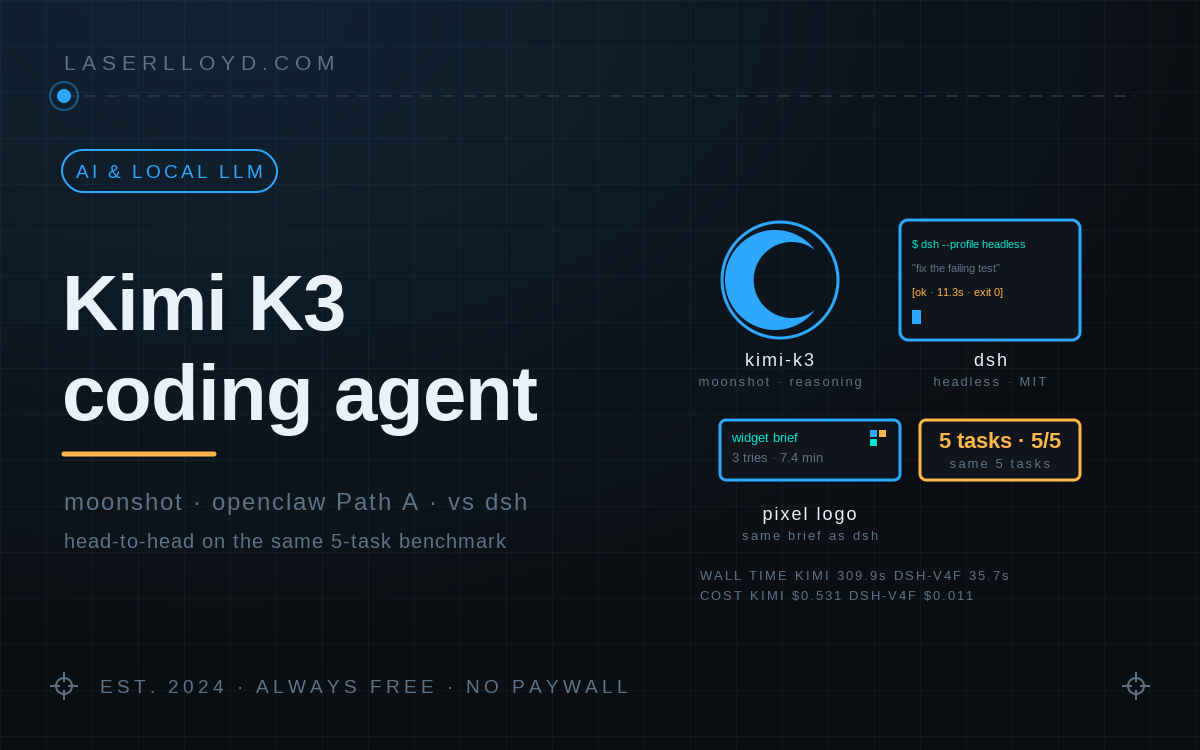
Kimi K3 in OpenClaw vs dsh: 5/5 Tasks, 9× Slower, 48× the Cost
Moonshot's Kimi K3 driving OpenClaw's agent loop on five small coding tasks: 5/5 passes, about 9× slower and 48× more expensive than dsh on DeepSeek V4-Flash's warm pass (22× against its cold pass). The pixel-art widget brief took three attempts.
How I Built OMLA by Directing AI Agents Instead of Writing the Code
One guy, no backend team: I directed AI coding agents to build a real royalty-licensing platform for a nonprofit, audits and gated deploy included. The actual process, not the highlight reel.
How to Have an LLM Adapt Any Project to Your System
The general recipe for taking any open project — a GitHub repo or a zip from this site — and having an AI assistant make it run on your machine, even if you don't code.
Headless ComfyUI: Run It as a Service, Use It from Anywhere
The follow-up to my AMD ComfyUI build: run it headless as a systemd service, drive it from scripts over the HTTP API, and use the browser UI securely from any device — while every workflow still saves to the box.
I Built My Family a Japan Trip Itinerary App With AI Inside
A private, PIN-gated itinerary web app for a family trip to Japan — day-by-day plans, live weather, offline support, and a built-in AI assistant that can answer questions and make small edits. Here's how it came together, gotchas and all, with a scrubbed sample you can download.

DeepSeek: Running Locally — a 4-Step Guide (No Experience Needed)
A four-step guide to running DeepSeek on your own PC with Ollama, Docker, and Open WebUI. No cloud account, no subscription — just a graphics card with 8 GB of vRAM.
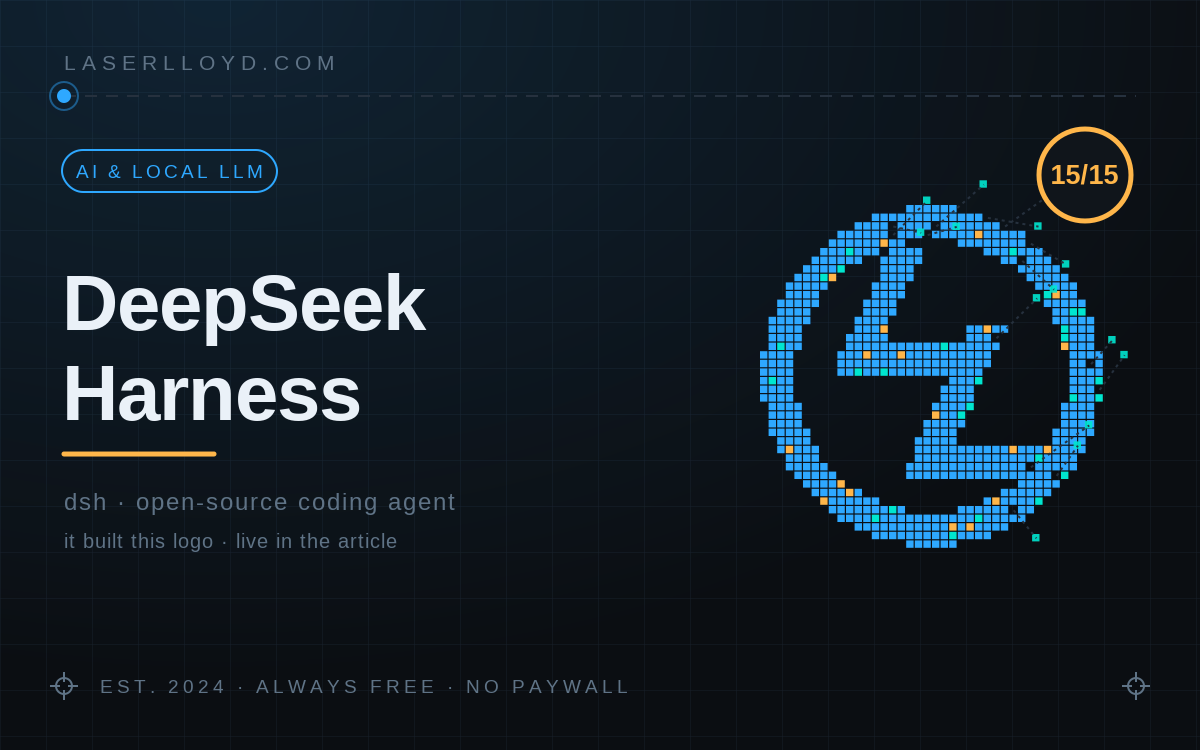
DeepSeek Harness (dsh): Install, Headless Runs, 3-Model Benchmark
DeepSeek's MIT-licensed coding agent, installed five days after release: npm install, a headless one-shot mode built for scripts, a systemd unit, model switching in one YAML file, and 15/15 passes on V4-Flash, V4-Pro and a local Gemma for a few cents.
DeepSeek Everywhere: Claude Code and a Local Agent Stack
In July 2026 DeepSeek quietly backed both my home agent stack and Claude Code. Here are the three copy-pasteable wiring patterns, including the systemd trick that keeps the API key out of argv entirely.
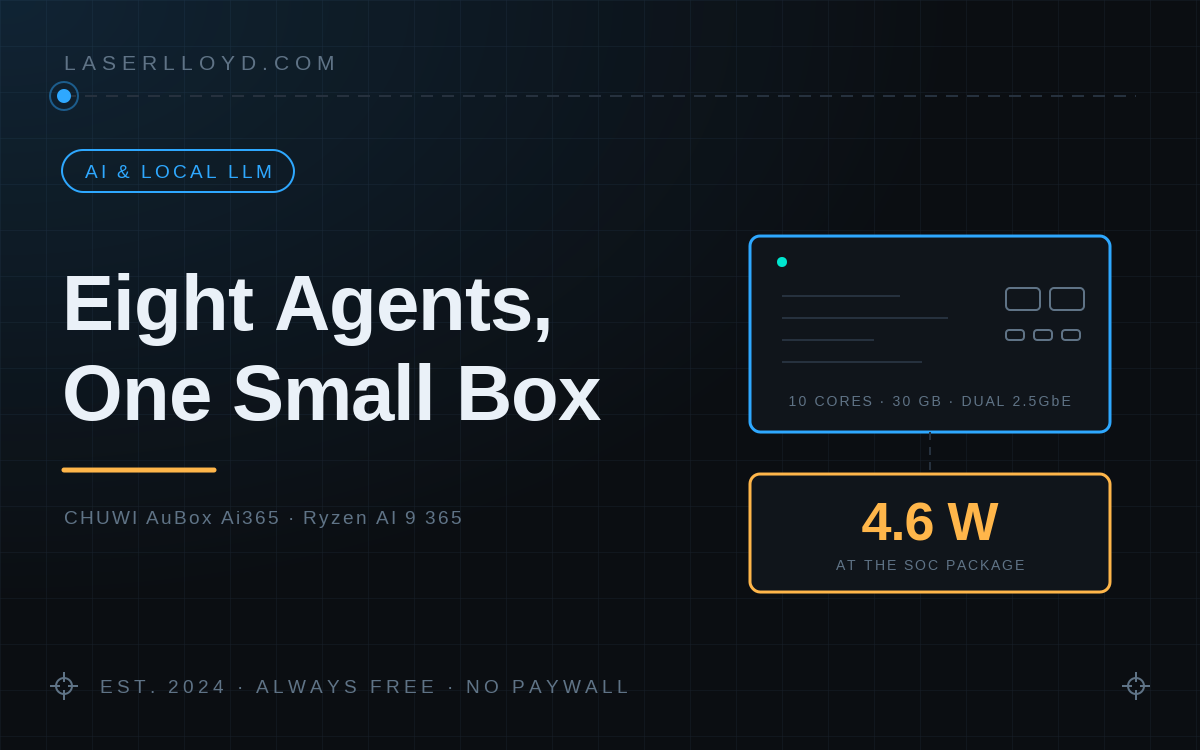
The CHUWI AuBox Ai365: My AI Home Lab in a Box
An obscure Strix Point mini PC with dual 2.5GbE, USB4 and a Ryzen AI 9 365. It runs Bluefin Linux on in-tree drivers, hosts my six-agent AI stack and draws 4.6 W at the chip. It replaced a dead 128 GB tablet.
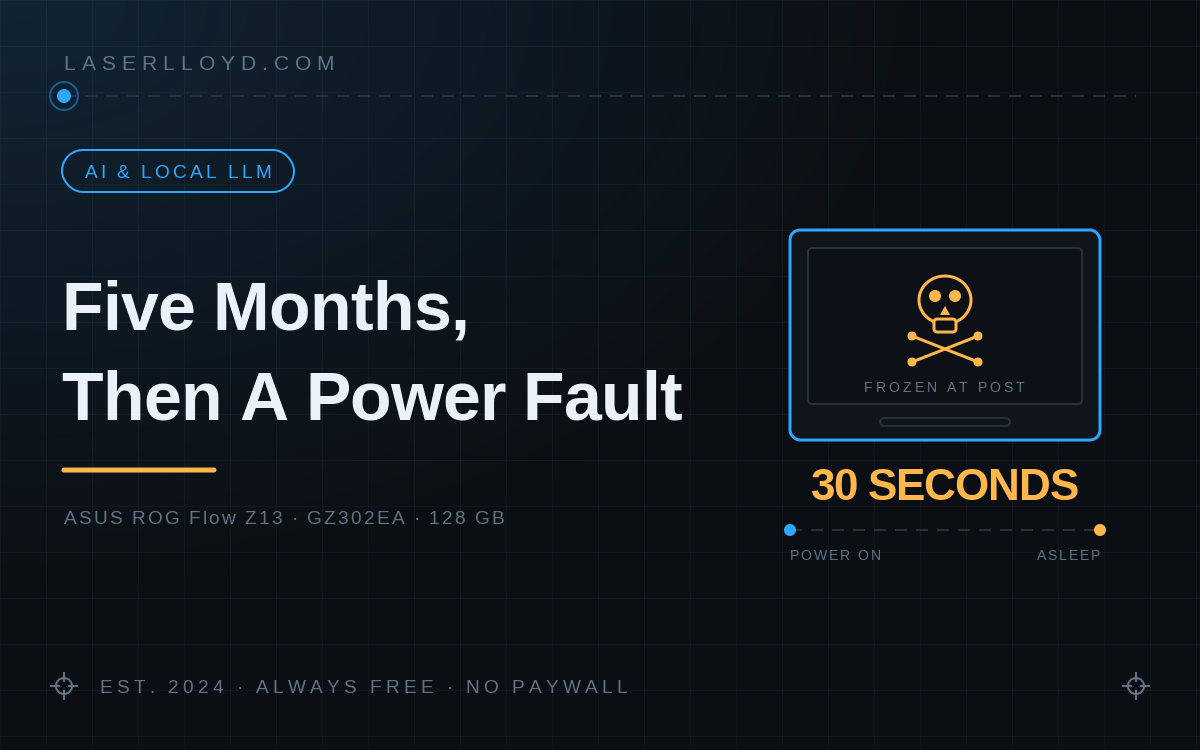
ASUS ROG Flow Z13: My Portable Home Lab That Refused to Stay Portable
A 128 GB gaming tablet ran my AI agents, my websites, and my whole home network — until a power fault started dropping it into sleep 30 seconds after every power-on. Here's the full post-mortem.
WordPress to Static With Claude Code: A Site Rebuilt in an Afternoon
This site used to run on WordPress. An AI coding agent rebuilt it as Markdown files plus a 183-line Python generator in an afternoon — and the same workflow still maintains it.

AI Chef: A Free System Prompt for Weekly Meal Planning
One copy-paste system prompt turns a chat AI into ProChef: weekly dinner plans, real recipes, and a grocery list already sorted by store section. Runs on my local Ollama box, but plain ChatGPT works too.