MIT-0 license: why every Laser Lloyd project uses it
- Category
- AI & Local LLM
- Posted
- November 2, 2026
- By
- Jacob Lloyd — written with AI assistance, post-project
- Read time
- 6 min read
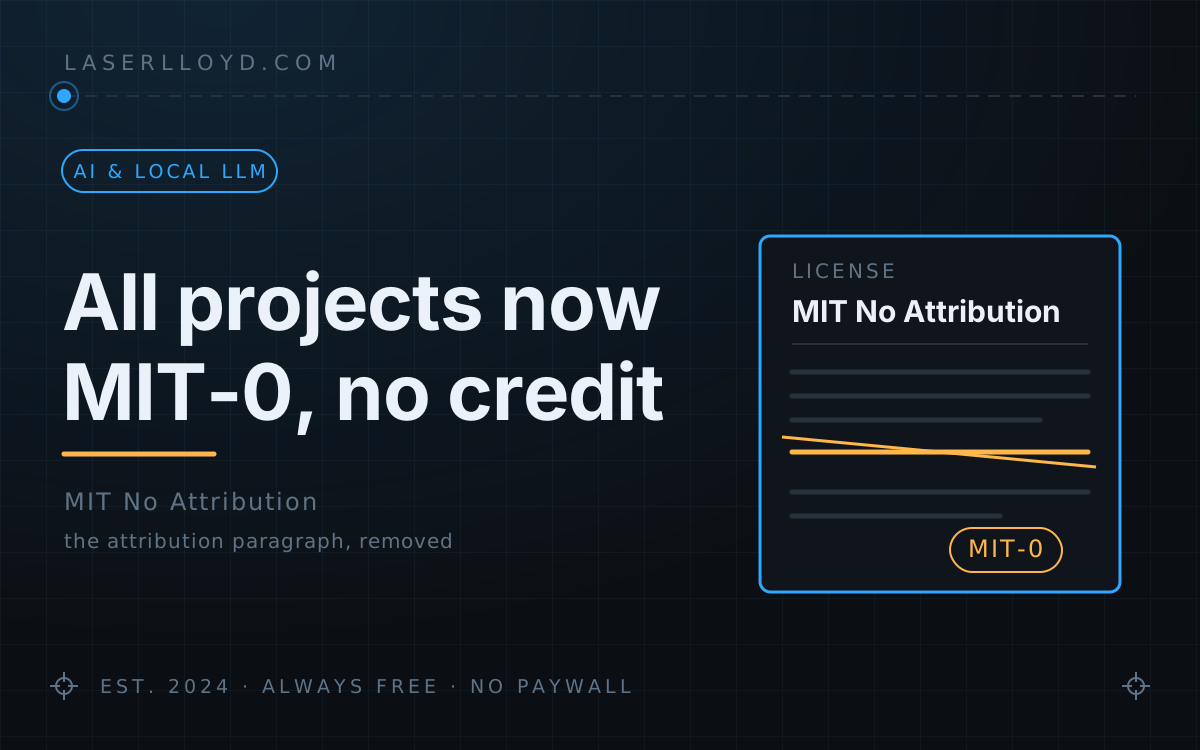
In plain terms: My open-source projects used to ask you to keep a copyright notice if you reused them. Now they use MIT-0, a licence that removes that requirement: you can copy the code into your own product, even a closed-source one, without carrying my notice or crediting me. The third-party libraries that came bundled with those projects still keep their own licence, and one optional add-on stays on the GPL because it imports GPL code.
MIT-0 (also called MIT No Attribution) is the MIT licence with one sentence removed: the one that says you must keep the copyright notice in every copy. Between 21 October and 1 November 2026 I moved every open-source project I publish to it: ten repositories changed, one add-on did not.
tl;dr
- What changed, and when: all ten of my open-source repositories now carry MIT-0 instead of MIT - ThemeForge on 21 October 2026, six more on 26 October 2026, the last three on 1 November 2026.
- What MIT-0 is: the MIT licence with the attribution paragraph removed. SPDX lists it as
MIT-0, "MIT No Attribution"; OSI approved it on 14 August 2020. - What it means for you: you may use, change, sell and sublicense the code, and unlike MIT it does not require you to keep my notice.
- What did not change: third-party and vendored code keeps its own licence, the optional Kokoro voice plugin stays GPL-3.0-or-later, and ClawForge stays proprietary.
What does MIT-0 mean for reusers?
Practically: you can take one of these projects, put it inside a product you sell, and keep neither my notice nor my name.
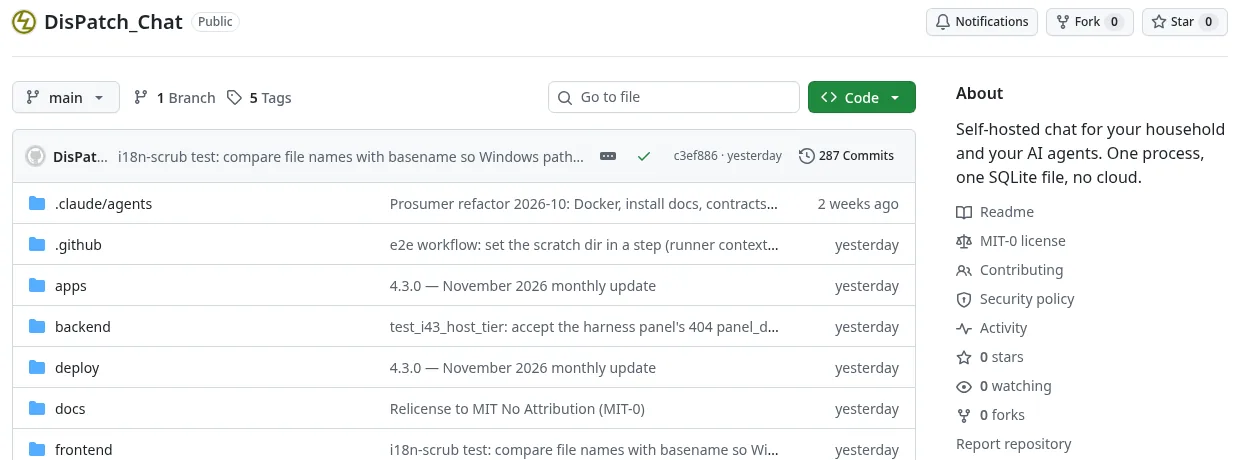
Each project has its own write-up: DisPatch Chat, StudioForge, ThemeForge, TransForge, ChatForge.
| Project | What it is | Relicensed |
|---|---|---|
| ThemeForge | Drop-in CSS themes and components | 21 October 2026 |
| ChatForge | Windows notification-area AI assistant | 26 October 2026 |
| CrucibleForge | LLM benchmark with a web GUI | 26 October 2026 |
| DisPatch Voice | Voice-chat add-on for DisPatch Chat | 26 October 2026 |
| InfoForge | Answers from local Wikipedia | 26 October 2026 |
| MailForge | Local email triage and draft assistant | 26 October 2026 |
| TransForge | Website translator for a local LLM | 26 October 2026 |
| DisPatch Chat | Self-hosted AI chat app, no cloud | 1 November 2026 |
| SpeechForge | GPU speech server for voice chat | 1 November 2026 |
| StudioForge | Self-hosted GPU-only llama.cpp server | 1 November 2026 |
What does the MIT-0 license text say?
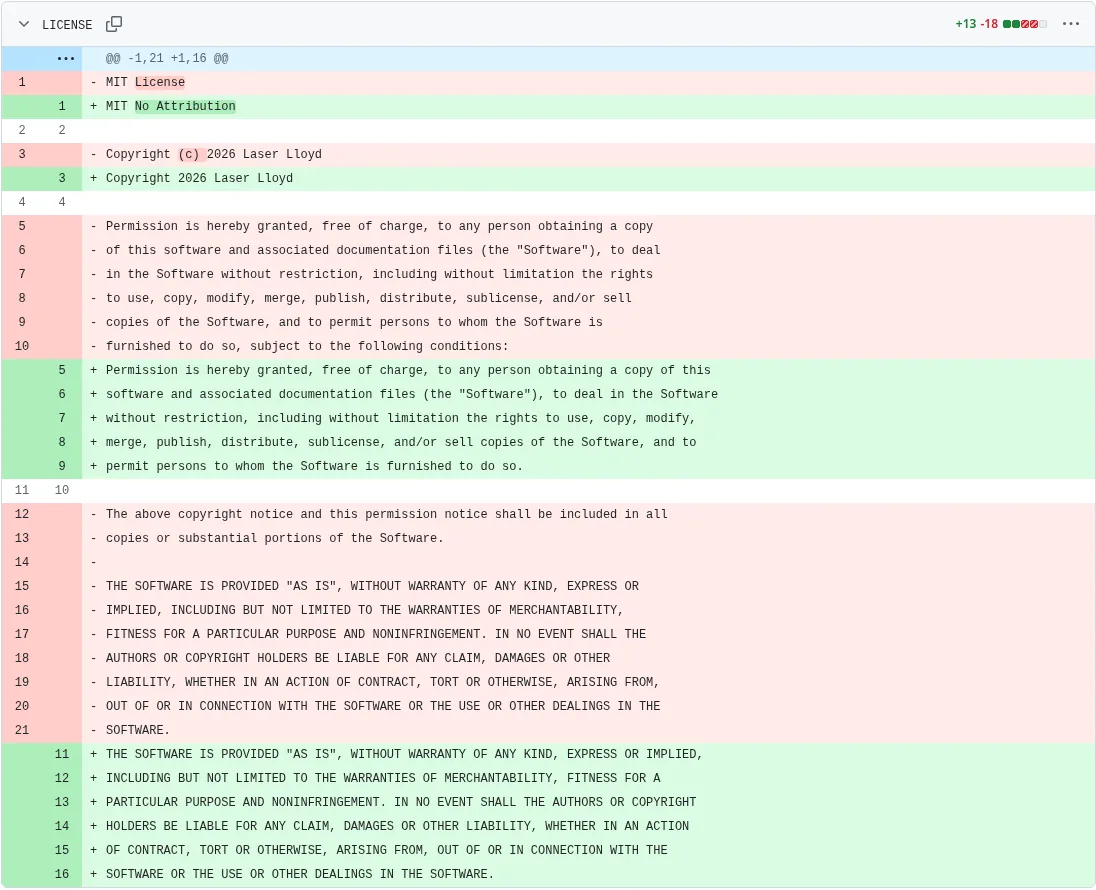
MIT's permission grant with the notice condition deleted, plus the usual "AS IS" warranty disclaimer and no liability. The whole thing is 16 lines - the LICENSE file of every repository above, and what GitHub shows you:
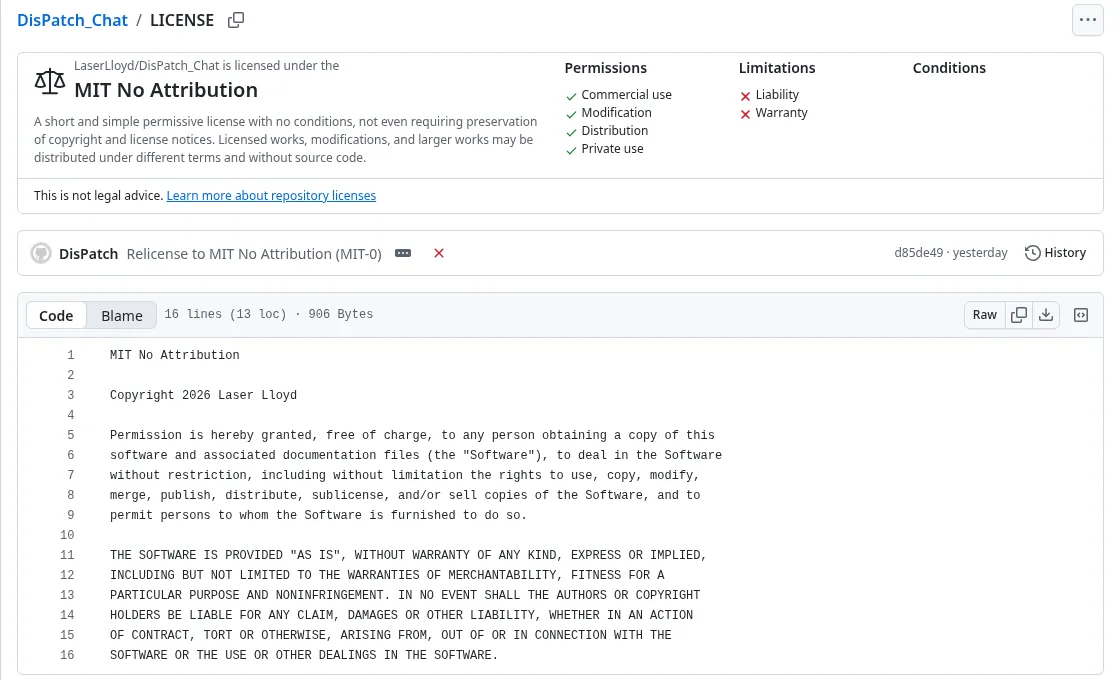
The one sentence MIT has and MIT-0 does not: "The above copyright notice and this permission notice shall be included in all copies or substantial portions of the Software."
What is MIT-0, and how is it different from MIT?
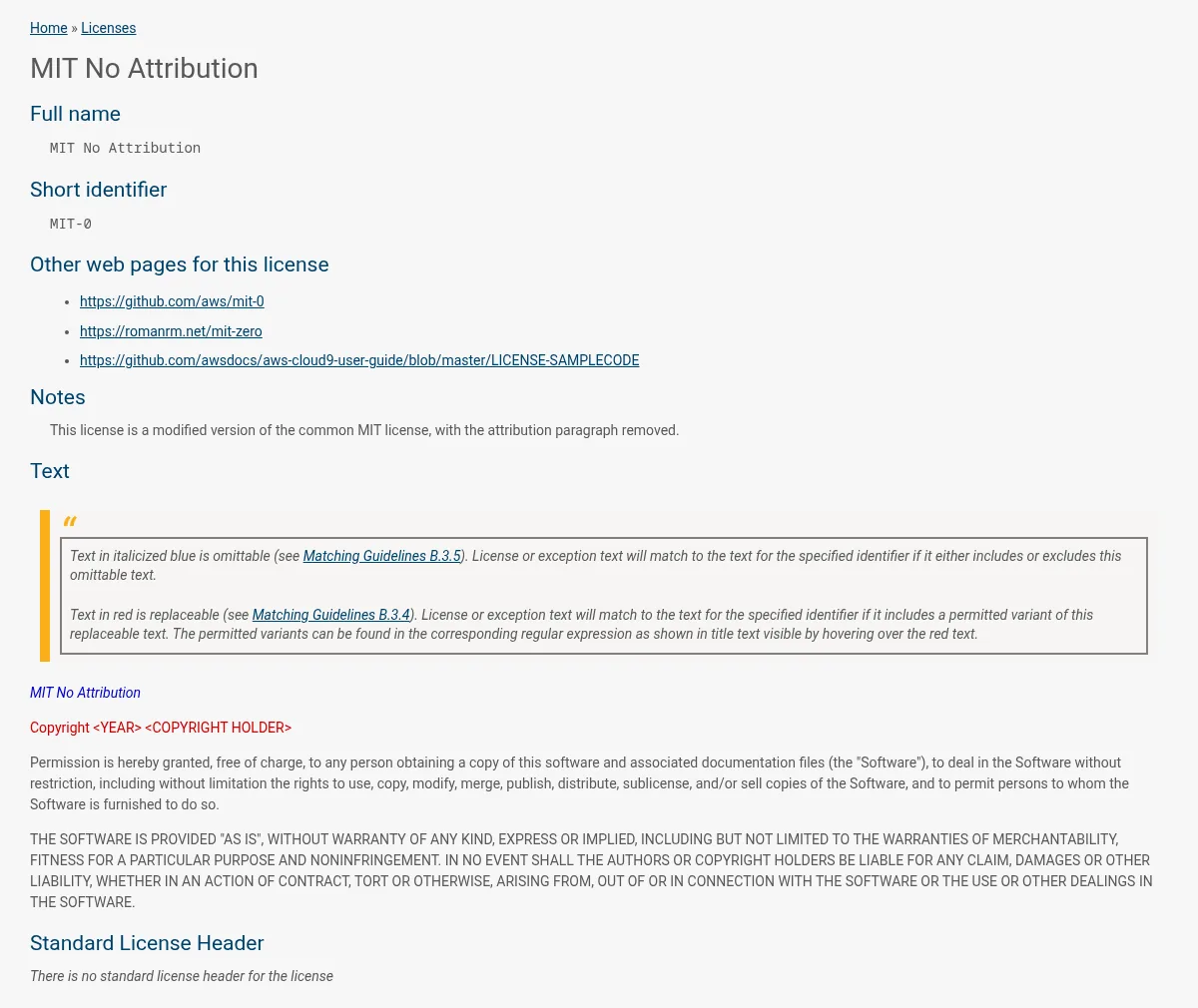
It is a registered licence with a standard identifier, not a home-made "do what you want" notice: the SPDX licence list entry for MIT-0 calls it "MIT No Attribution", and the OSI licence page records approval on 14 August 2020 (submitted 15 May 2020). The reference implementation says it "removes the requirement for attribution" - useful for reference code and templates.
- Use, copy, modify, merge, publish, distribute, sublicense and sell, plus the warranty disclaimer: yes in both, word for word.
- Keep the copyright notice and permission notice in all copies: MIT says yes, MIT-0 says no.
- Any condition on the licence of your own code: neither text has one.
One caveat: this is my reading of the licence texts and the standards pages, not legal advice; if a licence question matters to your business, ask a lawyer. The copyright line in the file still names me as the holder.
What did not move to MIT-0?
Third-party and vendored code keeps its own licence. DisPatch Chat inventories its vendored frontend libraries with their licence texts, and its Python dependencies keep their own terms - if you reuse those, you follow their terms, not mine.
The optional Kokoro voice plugin stays GPL-3.0-or-later. It is packaged on its own: the Kokoro runtime converts text with phonemizer, which is GPL-3.0-or-later, and phonemizer loads espeak-ng - also GPL-3.0-or-later - into the same Python process. Its README takes the position that code which loads GPL code in the same process forms a combined work with it: redistributing DisPatch with the plugin has to be done under GPL-3 terms, while private use is fine. The Kokoro model weights it downloads are Apache 2.0.
ClawForge stays proprietary - its LICENSE file says all rights are reserved and no licence is granted. Older releases keep the licence they shipped with: a relicense applies from the commit onwards, so for an older DisPatch Chat tag, read the LICENSE file that came with it.
How do I relicense: the DisPatch Chat commit, step by step
Only the copyright holder (or everyone who holds copyright in the code) can relicense a repository; if others contributed, get their agreement first. Here it is as actually done - one commit in DisPatch Chat.
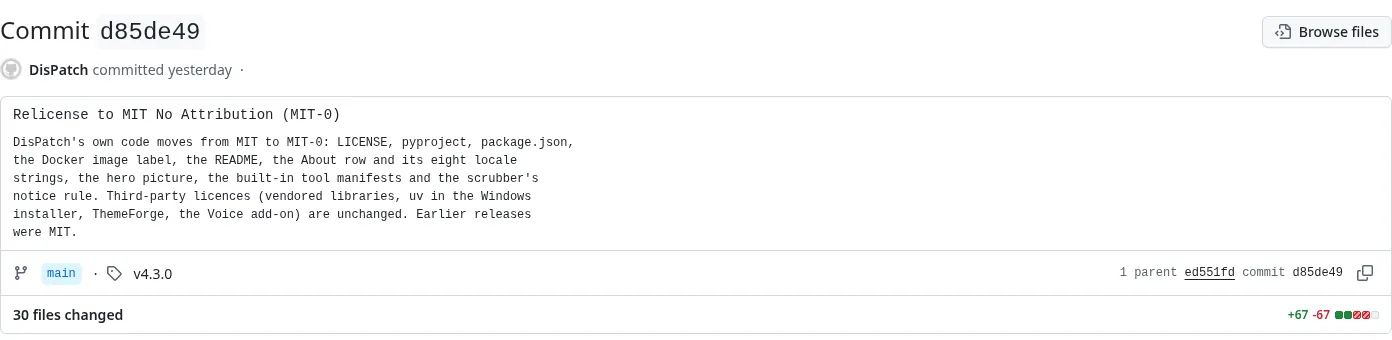
That commit changed 30 files for +67 and -67 lines; the Python lock file stayed unchanged. Seven steps:
- Replace the
LICENSEfile with the SPDX text. Take the canonical text from the SPDX page, not from a blog post, and keep the copyright line with your own name: a licence that differs by a word is harder for tools to recognise.
- Update the metadata your installer publishes.
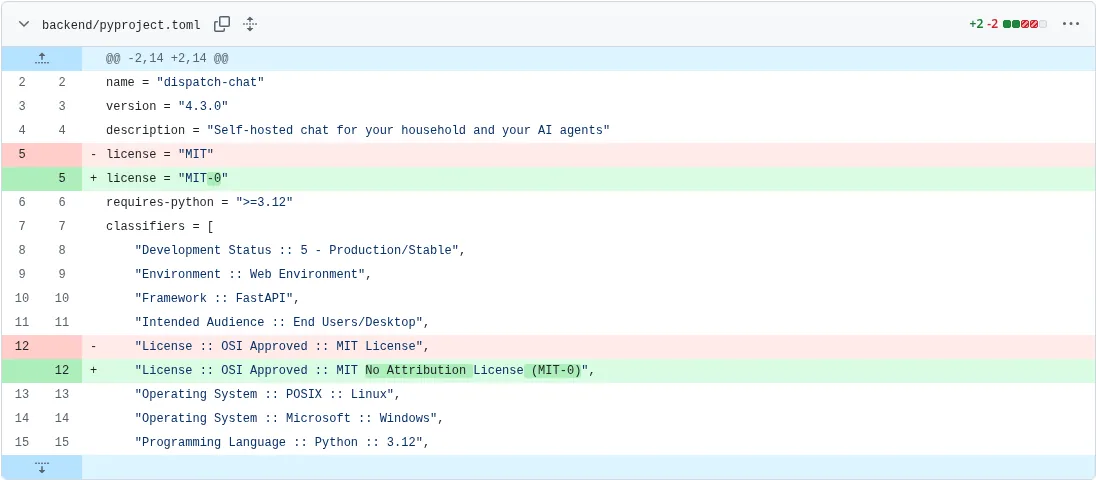
license = “MIT-0”plus the trove classifierLicense :: OSI Approved :: MIT No Attribution License (MIT-0)in the Python project file,“license”: “MIT-0”in the npm manifest, andorg.opencontainers.image.licenses=”MIT-0”as the Docker image label.
-
Update what humans read. The README licence paragraph and badge, the changelog entry, and what the app shows the user - DisPatch Chat’s About row and its eight locale strings all name the new licence.
-
Leave other people’s licences exactly as they are. The voice add-on, StudioForge, ThemeForge, the vendored libraries and the Windows installer’s bundled licences were left as they were.
-
Fix your own tooling. DisPatch Chat’s pre-commit scanner encoded the old licence - one rule said “MIT requires the copyright notice to survive verbatim”. That rule was rewritten for MIT-0 in the same commit.
-
Say what changed and what the old releases were. “Relicensed to MIT No Attribution (MIT-0) … Earlier releases were MIT.” One changelog paragraph. DisPatch Chat’s Windows installer needed no change: its licence page points at the
LICENSEfile. -
Check the paths you forget. Image labels, the About screen, the locale files, the installer’s licence page, release scripts, the README badge.
FAQ: common questions about the MIT-0 license
Is MIT-0 compatible with MIT?
The two texts share the same permission grant and the same warranty disclaimer; the only difference SPDX describes is the removed attribution paragraph. Whether a combination suits your project is a question for a lawyer.
Do I need to credit the author of MIT-0 code?
No. The MIT-0 text contains no credit or notice requirement, and the READMEs say a link back is appreciated but optional. The exceptions are the parts that are not MIT-0, such as vendored libraries.
Can I use MIT-0 code in a closed-source product?
Yes: the text grants permission to use, copy, modify, merge, publish, distribute, sublicense and sell, and has no condition about releasing your source. That is the licence text, not legal advice. Check every bundled component - Kokoro is GPL-3.0-or-later, ClawForge proprietary.
Which SPDX identifier do I put in my package metadata?
MIT-0, as in license = “MIT-0” in a Python project file or “license”: “MIT-0” in an npm manifest. OSI approved the licence on 14 August 2020.
Related: DisPatch Chat - StudioForge 2.0 - ThemeForge - TransForge.